To chase payment politely, you must chase the relationship, not just the invoice. Match the tone of each reminder to how important and reliable the account is, track every promise to pay, and follow up the day it slips. Let a person, not a template, handle the hard conversations. This is how to chase payment politely without risking a key account.
A single wrong-toned email can feel riskier than an ageing invoice, but silence sends its own message. This guide gives you a calibrated, step-by-step process for getting paid, from the first polite payment reminder to the point of escalation. For a deeper dive, see the complete guide to freight collections.
Why finance teams under-chase big accounts
Every freight forwarder is a bank that doesn’t charge interest. You pay carriers in days and get paid in months, turning every shipment into a small, interest-free loan. Collections is where that cash comes back. Yet, finance teams often hesitate to chase their largest customers. The fear is reasonable: a clumsy payment demand sent to a major account can jeopardize more revenue than the invoice is worth.
The risk of silence
But not chasing is also a message. It tells the customer their payment isn’t a priority, that your credit terms are flexible, and that their invoice can wait. This normalizes late payment and can allow a small overdue balance to grow into a significant exposure. According to UK government research published in September 2024, 36% of businesses reported that customers generally paid later than the agreed terms, with the average share of late-paid invoices at 17% (Department for Business and Trade).
The answer is calibration, not courage
The solution isn’t to be braver; it’s to be more systematic. A calibrated approach to chasing payments uses a documented, proportionate sequence that separates an administrative reminder from a dispute or a credit control action. It allows your team to be firm on process while remaining courteous to the customer, protecting both your cash flow and your most valuable relationships. Knowing what a good DSO looks like is the first step; a calibrated collections process is how you achieve it.
Sort your accounts before you chase
Before you send a single reminder, sort your accounts into simple, practical tiers. You can run this in a spreadsheet, or let a collections system keep the tiers current for you (more on that below). A one-size-fits-all approach to chasing overdue invoices is a common mistake. The same overdue invoice requires a different conversation depending on the account.
Establish a three-tier system
Rank each customer on two dimensions: their commercial value (volume, margin, strategic importance) and their payment reliability (average days to pay, dispute frequency). This creates a simple three-tier view:
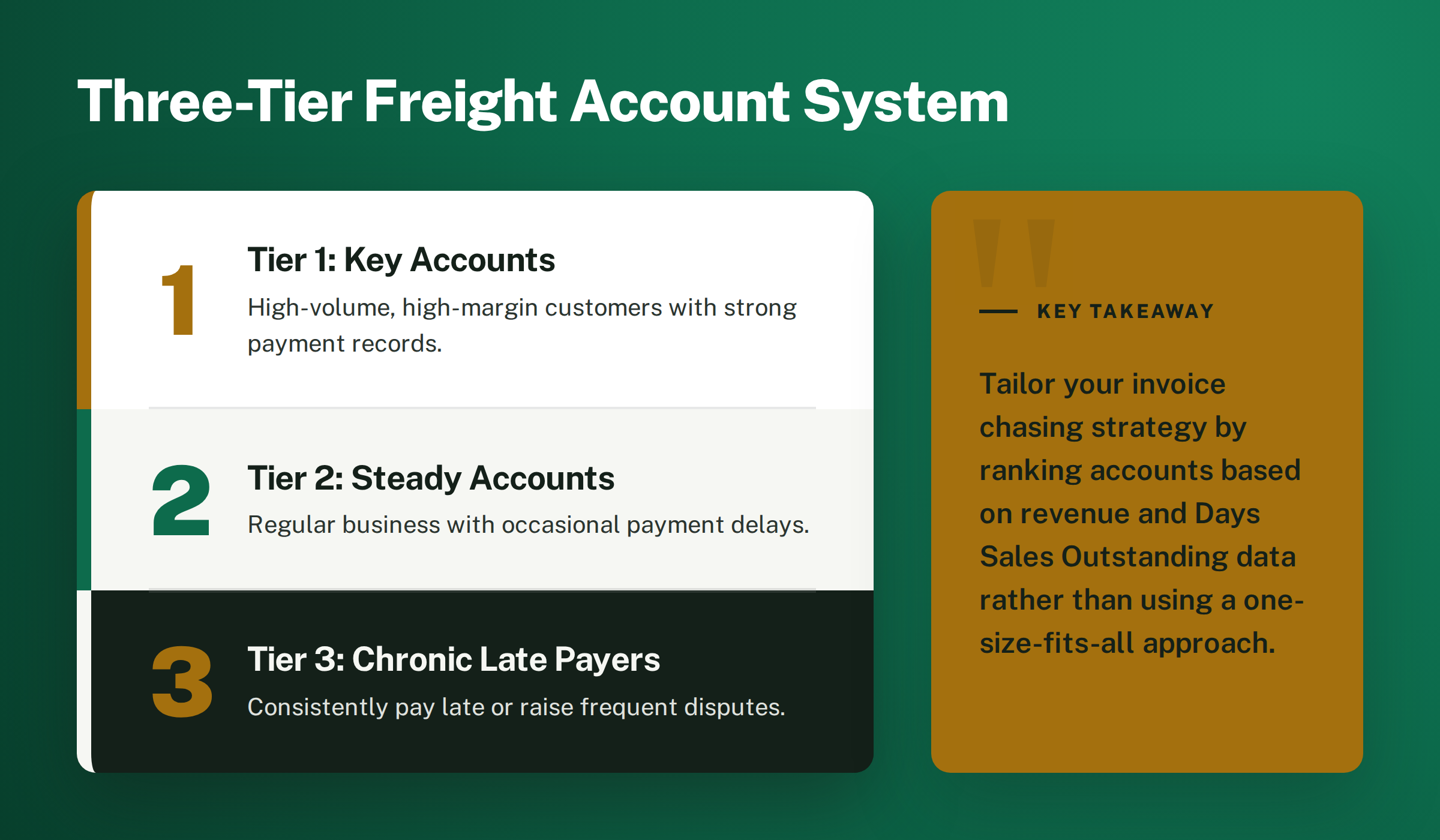
- Tier 1: Key Accounts. These are your high-volume, high-margin, or strategically vital customers with a historically strong payment record. The relationship is paramount.
- Tier 2: Steady Accounts. These customers provide regular business and generally pay on time, with occasional delays. They form the bulk of your ledger.
- Tier 3: Chronic Late Payers. These accounts consistently pay late, raise last-minute disputes, or require multiple reminders, regardless of the volume they generate.
Base tiers on data, not feelings
Use your ageing report analysis and sales data to inform the tiers. A high-volume customer paying 90 days late on shipments through Jebel Ali or Felixstowe is a high-risk key account, not a reliable partner. Your tiering should reflect this reality. Ask two questions for each account:
- How much business does it bring? (Revenue, gross margin, volume)
- How reliably does it pay? (Days Sales Outstanding (DSO), number of overdue invoices, promise-to-pay history)
Review and adapt your tiers regularly
Payment behaviour is not static. A reliable account can face cash flow issues; a late payer can improve with a new finance team. Review your tiers quarterly, and immediately reassess any account after a major change like a broken payment plan, a significant dispute, or a sudden increase in credit exposure.
The same overdue invoice, three reminders
Imagine one invoice is about 30 days past its due date. Here is how to chase payment politely with three different, copy-ready templates tailored to each account tier. Each example is a friendly payment reminder, but the tone and subtext are calibrated to the relationship.
1. For a Key Account: A colleague's note
With a key account, the goal is to get visibility without creating friction. The tone is collaborative and assumes an administrative oversight.
Subject: Quick check on invoice [INV-12345]
Hi [Contact Name],
Hope you're having a good week. Could you let me know when invoice [INV-12345] for USD [Amount] is scheduled for payment?
If anything is holding it up on your end, just let me know and I'll get it sorted right away.
Thanks,
[Your Name]
Why it works: It’s personal, non-accusatory, and doesn't quote payment terms. It frames the overdue payment as a shared problem to solve, reinforcing the partnership.
2. For a Steady Account: Polite, specific, and documented
For a reliable customer who is uncharacteristically late, the reminder is still polite but more formal. It cites the facts and provides the necessary documents.
Subject: Payment Reminder: Invoice [INV-12345] - [Your Company Name]
Hello [Contact Name],
This is a friendly reminder that invoice [INV-12345] for USD [Amount] was due for payment on [Due Date]. It is now approximately 30 days overdue.
Our agreed terms are [e.g., 30 days from invoice date]. I've attached a copy of the invoice and the current statement of account for your convenience.
Could you please let us know when we can expect to receive payment? If you've already sent it, please disregard this message.
Kind regards,
[Your Name]
Why it works: It clearly states the invoice number, amount, and due date. It references the agreed terms and attaches a statement of account template, giving the accounts payable team everything they need to process the payment.
3. For a Chronic Late Payer: Direct and consequential
When dealing with a customer who has a history of late payments, the tone must be firm and direct. The focus shifts from reminding to establishing a clear deadline and consequence.
Subject: Action Required: Overdue Invoice [INV-12345]
Dear [Contact Name],
Our records show that invoice [INV-12345] for USD [Amount], due on [Due Date], remains unpaid.
Please arrange for immediate payment. We require payment or a remittance advice by [Date - e.g., 3 business days from now].
As per our credit policy, if the overdue balance is not cleared by this date, the account will be placed on credit hold. This may prevent the release of current shipments or the acceptance of new bookings on credit terms.
Regards,
[Your Name/Credit Control Dept.]
Why it works: It is unambiguous. It sets a clear deadline and states a specific, business-appropriate consequence, moving the conversation from a polite request to a formal credit control action.
Track every promise to pay
When a customer says they will pay on Thursday, that is a commitment. The most effective way to improve collections is to treat it as one. A disciplined promise to pay log does more to reduce DSO than a stern email ever could.
Log the specifics
A vague note that "customer will pay next week" is useless. Your log, whether in a spreadsheet or your TMS, must be specific.
For every promise, record:
- Customer Name
- Invoice(s) Covered
- Promised Amount & Currency
- Promised Date
- Contact Person Who Made the Promise
- Date Logged
Stay quiet until the promise date
Once a promise is logged, stop chasing. Sending more reminders before the agreed date undermines the trust you've placed in their commitment and creates unnecessary noise. The only exception is if a condition of the promise (like you sending a revised invoice) has not been met.
Follow up the morning after
If the payment doesn't arrive by the morning after the promised date, follow up immediately. The message should be factual, not emotional.
“Hi [Name], following up on your promise to pay invoice [INV-12345] yesterday. We haven’t received the funds yet. Could you please share the remittance advice or an update?”
This simple discipline of tracking and following up on every broken promise is a cornerstone of effective credit control best practices.
When a person should take over
Automated reminders and templates are efficient for routine follow-ups, but there are clear moments when a person must step in. A template cannot resolve a complex dispute or salvage a strained relationship. A conversation is needed for:
- Complex disputes: The invoice is blocked by a genuine issue.
- Repeated broken promises: The standard process isn't working.
- Significant age or value: The invoice is 60+ days overdue or the exposure is high.
- Key accounts: The relationship requires a personal touch.
First, check for disputes
Before picking up the phone, investigate why the invoice is unpaid. Is it simple non-payment, or is it one of the many invoices blocked by detention and demurrage disputes? In the U.S., for example, the Federal Maritime Commission's final rule on billing practices sets strict requirements for D&D invoices, including a 30-day window for carriers to issue them (FMC). An invoice that fails to meet these criteria may not even be payable. Chasing it as a simple overdue debt will only damage the relationship.
Arm the person with full history
The person making the call—whether an account manager or finance head—needs a complete brief. This includes the full invoice history, all previous communication, the promise-to-pay log, and details of any disputes. Their goal is to leave the call with a clear, dated action plan owned by a specific person on each side.
Mistakes that damage relationships
Knowing how to chase payment politely is as much about avoiding errors as it is about using the right templates. These common mistakes can turn a routine collection call into a relationship-ending incident.
1. Chasing an invoice that was already paid
This often happens when a customer makes a single lump-sum payment for multiple invoices. If your team hasn't completed the reconciliation, you might chase an invoice that's already been settled. Before sending any reminder, check for unapplied cash on the account. Proper techniques for applying lump-sum payments to invoices are critical.
2. Ignoring a known dispute
Chasing an invoice that is under a genuine, documented dispute signals that you aren't listening. Treat disputed amounts separately. Acknowledge the dispute, assign an owner to resolve it, and continue to request payment for the undisputed balance.
3. Using a single template for everyone
Sending a harsh, automated demand to a strategic partner who has never paid late is a fast way to lose a key account. As shown above, the tone must be calibrated to the customer's tier and payment history.
4. Threatening consequences you won't apply
Empty threats—like threatening to suspend services when you have no intention of doing so—destroy your credibility. In the UK, for example, while you may have a statutory right to charge interest on late commercial payments, you should only mention it as part of a formal, escalated process, not as a casual threat. According to GOV.UK, the statutory rate is 8% plus the Bank of England base rate, but applying it should be a deliberate policy decision.
Where Receivables AI fits
Managing this calibrated process across hundreds of customers and thousands of invoices is challenging with spreadsheets and email alone. This is where a dedicated system like Receivables AI, built on FreighAI, provides the necessary structure.
Receivables AI runs the three disciplines in this guide itself. It sets the tone of each payment reminder to the customer: warmer for a key account, firmer for a chronic late payer. It tracks every promise to pay and follows up when a promised date slips. And it moves customers between tiers on its own, from how they actually pay, so a key account that starts breaking promises is not still getting the gentlest reminders a quarter later.
Follow-ups, chasers and reminders are prepared on the same conversation, so the history stays in one thread. Control stays with your people: every reminder written to a customer waits for a person, who can edit, approve or reject it; an approved message goes out in their own name.
This human-in-the-loop design is crucial. The rules and timing for chasers and reminders are set by the head of operations or an admin, and they can be switched off for a specific customer or a sensitive lane. This provides the efficiency of automation without the risk of a poorly-toned message damaging a key relationship. It's a clear example of how specialized freight collections compared with generic AR tools deliver more value. You can see how the desk works to manage this balance of automation and control.
Frequently Asked Questions
How do you chase payment politely?
To chase payment politely, you should always start with the assumption of a simple oversight, not bad intent. Match the tone of your reminder to the customer's importance and payment history. Be specific about the invoice number, amount, and due date. Always provide an easy way for them to resolve the issue, such as by attaching the invoice or asking if they need any other documents.
What should a friendly payment reminder say?
A friendly payment reminder should be concise and helpful. It should include the invoice number, the amount due, and the original due date. A simple, non-confrontational question like, "Could you please let us know the status of this invoice?" or "I'm just writing to follow up on the attached invoice and see when it might be scheduled for payment" is effective. Always end on a positive and collaborative note.
How often should I chase an overdue invoice?
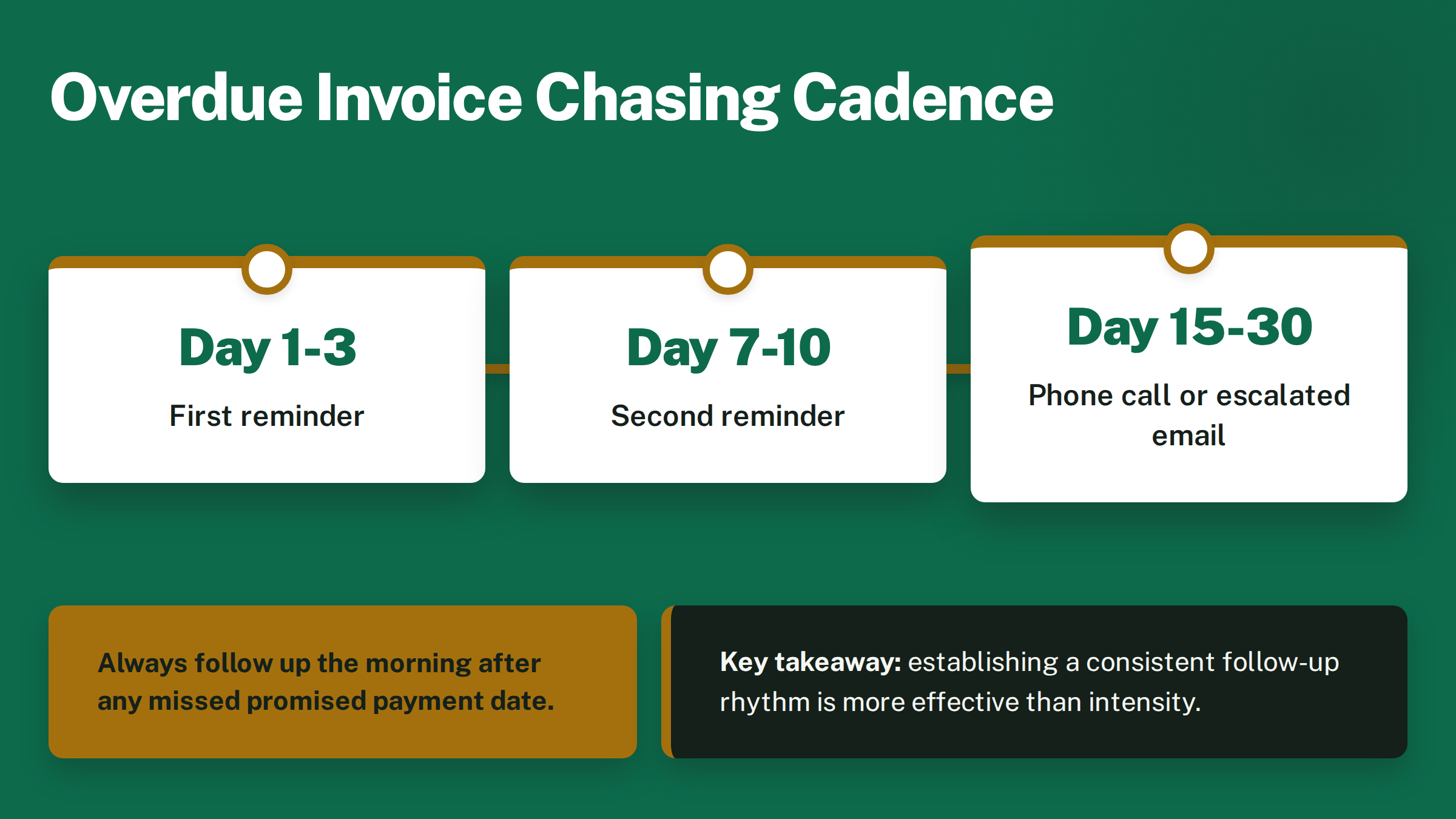
Establish a consistent rhythm for chasing payments. A typical cadence might be a first reminder 1-3 days after the due date, a second reminder 7-10 days later, and a phone call or escalated email around 15-30 days overdue. Crucially, you should always follow up the morning after any promised payment date is missed. Consistency is more effective than intensity.
When should I stop being polite when chasing payment?
You should never be rude, but you should become firmer and more direct as an invoice ages and promises are broken. The shift from "polite" to "firm" happens when a customer ignores multiple reminders or breaks a payment promise. At this point, the communication should clearly state the consequences of non-payment, such as a credit hold, as defined in your terms. This is a formal business communication, not a personal argument.
How should I handle a dispute on an overdue invoice?
When a customer disputes an invoice, immediately separate it from the standard collections workflow. Acknowledge the dispute in writing, ask for specific details and supporting evidence, and assign an internal owner to investigate. While the disputed amount is under review, you can and should continue to request payment for any other undisputed invoices or balances on the account.
Bring your AR aging report to a demo, and we’ll walk through where the cash is sitting.
Sources & References
This article draws on research and data from the following verified sources:
From reading to seeing.
Every idea on this page runs live in a working collections desk. Bring your aging report and watch.
Book the working sessionKEEP READING