The term ‘knock-off’ sounds like bookkeeping trivia until a lump-sum payment arrives from a major customer. The reference is vague: ‘JUNE PAYMENT’. The amount doesn’t match any single invoice. Until your finance team applies that receipt line by line, your aging report is wrong and your next reminder might chase an invoice that has already been paid. This is the daily reality of accounts receivable, and it’s a core part of the complete guide to freight collections.
For freight forwarders, this problem is magnified. Customers pay against a monthly statement of account (SOA), net off credit notes for service issues, and—in markets like India—deduct tax at source (TDS) from the same payment. Understanding the knock off meaning in accounting is the first step to untangling these complex receipts and maintaining a clean, accurate receivables ledger.
The short answer
The knock off meaning in accounting is the process of applying money received (or paid) against the specific invoices it settles. This action marks each invoice as paid, part-paid, or still open. The journal entry that records this allocation is often called a knock off entry. In a bill-wise accounting system, this entry creates a direct link between the receipt and each individual bill it clears, ensuring the customer's ledger is accurate.
What knock-off means, in plain terms
At its core, knocking off is about connecting the dots. It’s the formal accounting step that says, “This specific amount of money pays for that specific bill.” Without it, you have cash in the bank and a list of open invoices, with no link between them.
Receivables vs. Payables
The process works on both sides of the ledger:
- Accounts Receivable (AR): When a customer pays you, your team knocks off the receipt against the sales invoices it covers. This is the most common context for the term.
- Accounts Payable (AP): When you pay a supplier, like a carrier or an overseas agent, your team knocks off the payment against their bills.
The terms knock off payment meaning, knock off entry meaning, and even knock off invoice meaning all point to the same fundamental idea: matching cash to the transaction it settles. A knock off payment is the money being applied, the knock off entry is the record of that application, and the invoice is the item being cleared.
What happens without a knock-off?
If a receipt isn't knocked off, it sits in your system as "unapplied cash" or a general credit on the customer's account. The money is in your bank, but your accounting system still shows the original invoices as overdue. This creates a dangerously misleading picture of your receivables, suggesting a customer is late when they have, in fact, already paid.
Why knock-off is harder for forwarders
Freight forwarders are effectively banks that don't charge interest. You pay carriers in days and get paid by shippers in months. This makes efficient collections critical, but the nature of forwarding payments makes the cash application process uniquely challenging.
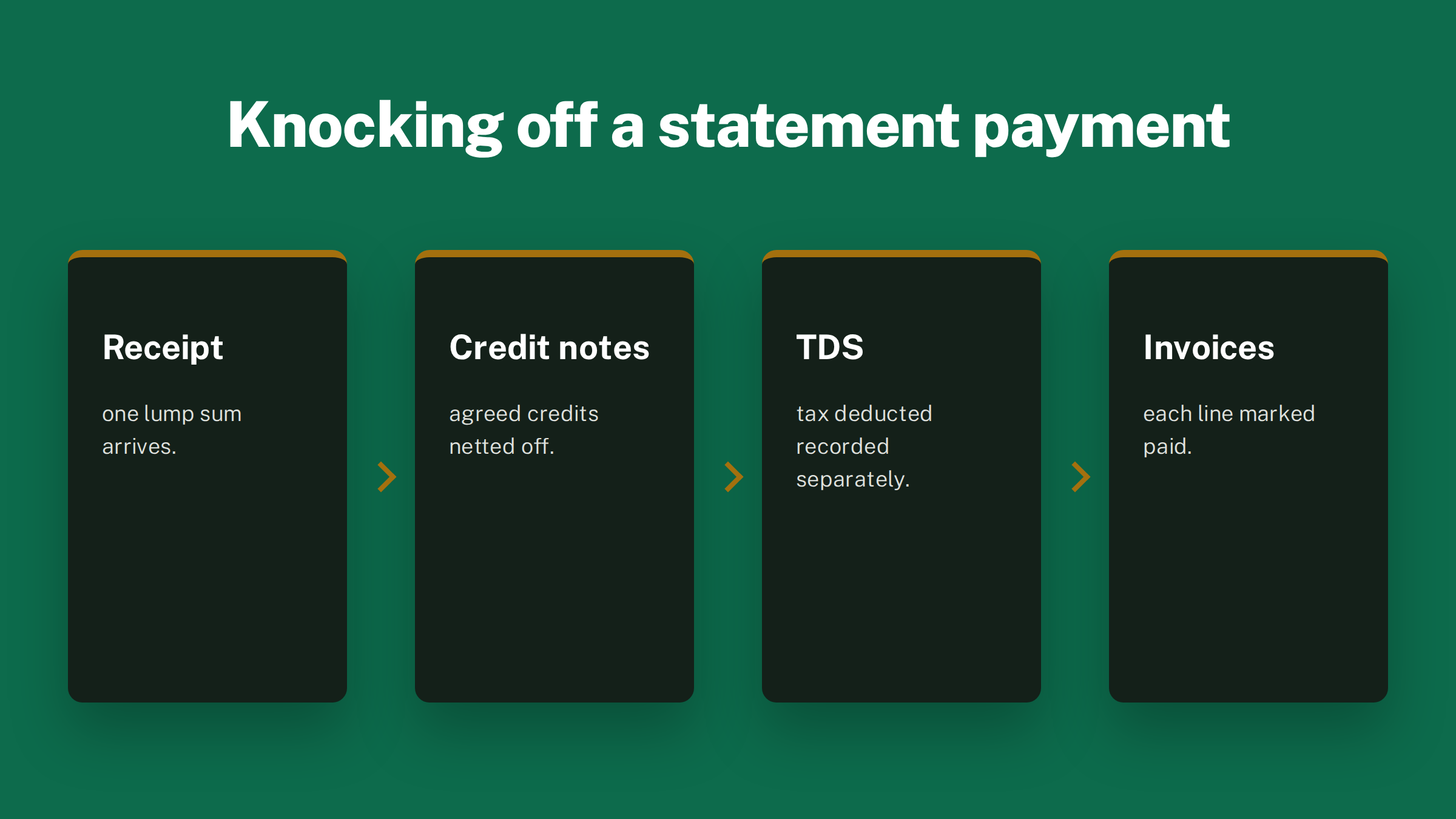
Customers pay the Statement of Account (SOA)
Major shippers rarely pay invoice by invoice. Instead, they pay against a monthly Statement of Account that consolidates dozens of shipments, each with its own invoice for freight, customs, and handling charges. Your finance team receives one large payment that needs to be allocated across many small, individual invoice lines.
Credit notes are netted off
If there was a service issue—for example, an agreed waiver for detention charges—the customer won't wait for you to process a refund. They will simply deduct the amount of the agreed credit note from their next SOA payment. The receipt arrives short, and it's up to your team to match the deduction to the correct, approved credit note.
Indian customers deduct TDS
In India, many business customers must deduct Tax at Source (TDS) on payments for freight and transport services. This means receipts from Indian customers arrive short by design. The difference isn't an underpayment or a dispute; it's a tax credit that your company must claim back. This is different from the challenges of managing post-dated cheques in the GCC, but it similarly complicates the cash application process.
Remittance references are vague
The final challenge is the payment reference itself. Instead of a list of invoice numbers, the bank transfer might simply say ‘JUNE PAYMENT’, ‘BEING PAYMENT AGAINST BILLS’, or nothing at all. Your team is left to reconstruct the payment allocation with little to go on, turning a simple accounting task into a complex reconciliation puzzle.
The TDS rule behind short receipts (India)
When an Indian customer’s payment arrives short, it’s often due to Tax Deducted at Source (TDS). Understanding this rule is key to avoiding chasing valid tax deductions as if they were underpayments.
Section 194C and Section 393(1)
The primary rule governing these deductions is for payments to contractors, which includes the carriage of goods. According to the Income Tax Department, under section 194C of the Income-tax Act, 1961, the TDS rates are:
- 1% where the payee is an individual or a Hindu Undivided Family (HUF).
- 2% for other payees, such as companies.
As of 1 April 2026, this provision is housed in a new section. According to tax guidance from TDSMAN, the rule moves to section 393(1) of the Income-tax Act, 2025, but the 1% and 2% rates remain the same.
Reconciling the TDS amount
The amount deducted by your customer doesn't just disappear. It is paid to the government on your behalf. Once the customer files their TDS return, the deducted amount appears in your company's tax credit statement, known as Form 26AS. Your finance team must match the TDS amount recorded in your books against Form 26AS before formally treating that portion of the invoice as settled. This is a crucial step in the knock off in accounting for Indian businesses.
A worked example: one statement payment
Let's walk through a typical scenario for a freight forwarder in India. A customer needs to settle a statement with three invoices, has an approved credit note, and will deduct TDS. All amounts exclude GST for simplicity.
The Scenario
Your customer's statement of account for June 2026 includes:
- Invoice A: ₹2,00,000
- Invoice B: ₹1,50,000
- Invoice C: ₹1,00,000
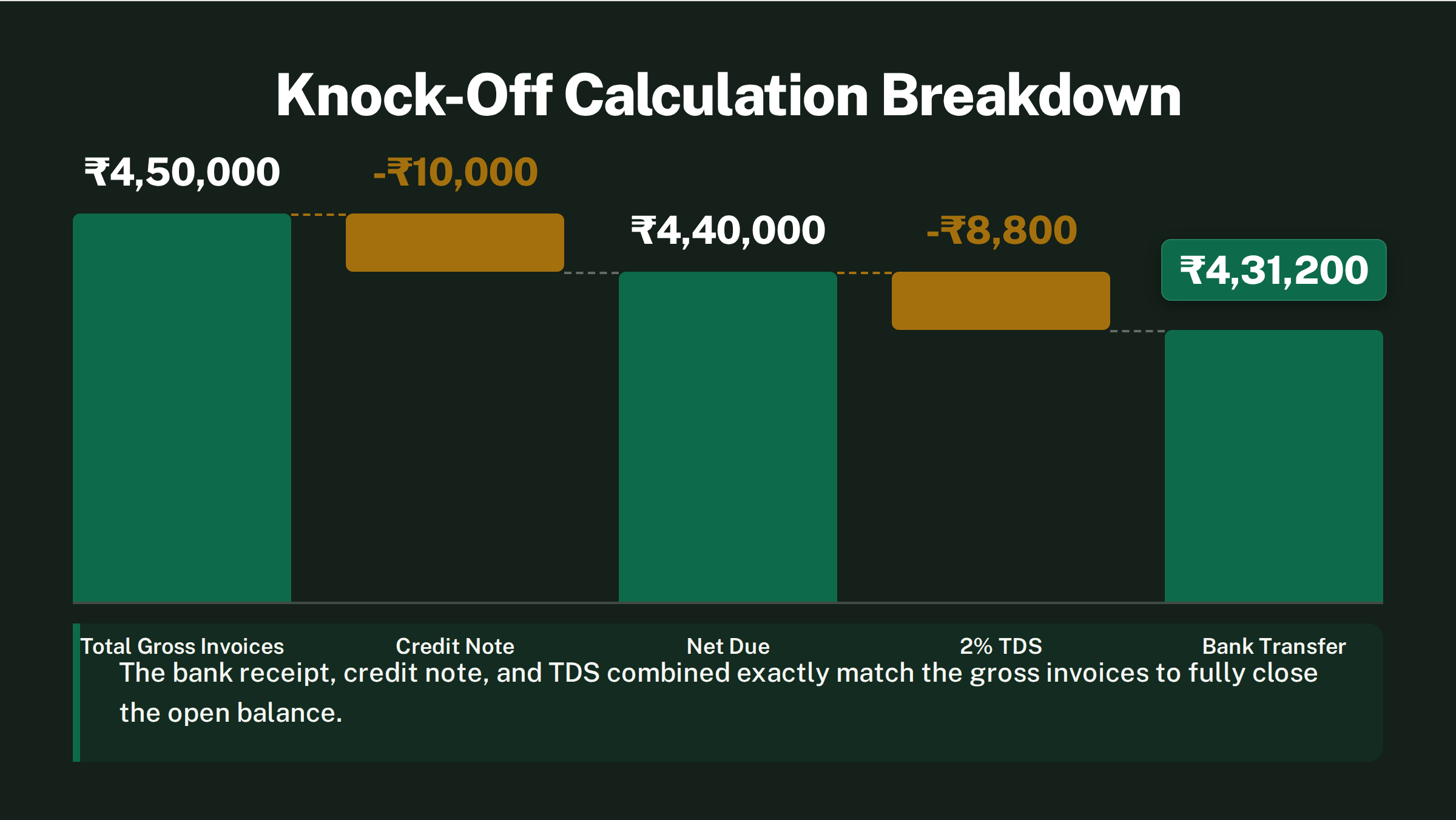
- Total Gross Invoices: ₹4,50,000
You have also issued an approved credit note for a detention waiver for ₹10,000. The customer is a company and will deduct TDS at 2%.
The Calculation
- Calculate the net due amount: The customer nets the credit note from the total.
₹4,50,000 (Invoices) - ₹10,000 (Credit Note) = ₹4,40,000 (Net Due) - Calculate the TDS: The customer deducts TDS on the net payable amount.
2% of ₹4,40,000 = ₹8,800 (TDS) - Calculate the final bank transfer: The customer pays the remaining balance.
₹4,40,000 (Net Due) - ₹8,800 (TDS) = ₹4,31,200 (Bank Transfer)
The customer transfers ₹4,31,200 with the reference ‘JUNE PAYMENT’.
The Knock-Off Process
Your finance team receives ₹4,31,200. To perform the knock-off, they must apply all three components—the receipt, the credit note, and the TDS—to the open invoices.
| Component | Amount | Action |
|---|---|---|
| Bank Receipt | ₹4,31,200 | Applied to open invoices |
| Credit Note | ₹10,000 | Applied to open invoices |
| TDS Receivable | ₹8,800 | Posted to a separate TDS receivable account and applied to invoices |
| Total Applied | ₹4,50,000 | Matches total gross invoices |
The total applied amount (₹4,31,200 + ₹10,000 + ₹8,800) is ₹4,50,000. This exactly matches the gross value of invoices A, B, and C. After this knock off entry, all three invoices are fully closed, and the ₹8,800 is tracked as a receivable from the tax authorities, not as a shortfall from the customer.
What goes wrong when knock-off is late or wrong
A slow or inaccurate cash application process does more than just create messy books. It actively damages your cash flow, customer relationships, and ability to make sound financial decisions.
The aging report becomes unreliable
When a lump-sum payment sits as unapplied cash, the invoices it was meant to pay remain in your aging report, appearing overdue. This overstates what is truly late and, worse, hides the invoices that genuinely need chasing. Your credit control team ends up working from a flawed list, wasting time on settled bills.
Reminders chase paid invoices
The most immediate damage is to customer trust. Sending a reminder for an invoice that was part of a recent SOA payment makes your finance department look disorganized. It costs credibility and prompts frustrated replies from your customer’s accounts team, who then have to spend their time proving they already paid.
TDS shortfalls are chased as underpayments
Without a clear understanding of the knock off meaning in accounting for TDS, a system might automatically flag the 2% shortfall as an underpayment. This leads to pointless collection calls about a valid tax deduction, creating unnecessary friction with customers in India who are simply following the law.
Unapplied cash distorts your financial picture
A growing balance of unapplied cash in a suspense account is a red flag. It means your Days Sales Outstanding (DSO) is artificially inflated because the cash hasn't been matched to the receivables. This gives a false impression of poor collection performance and makes it difficult to forecast cash flow accurately. You can learn more about how statement payments and TDS distort DSO in our detailed guide.
A simple knock-off routine
A disciplined cash application process can prevent most of these problems. By following a consistent routine, your finance team can ensure that every payment is knocked off quickly and accurately.
1. Ask for a remittance advice
Proactively ask your customers to send a remittance advice with every payment, especially for SOA settlements. This document is your roadmap, detailing which invoices, credit notes, and deductions are included in their payment.
2. Match receipt to statement and documents
Start with the bank receipt and match it to the remittance advice and the customer's statement. Then, drill down to the individual invoices and credit notes. This confirms that the gross amounts, deductions, and net payment all align before you post anything.
3. Record TDS separately
When you identify a TDS deduction, don't just reduce the invoice amount. Post the tax portion to a dedicated "TDS Receivable" account. Later, tick off this entry when the credit appears in your Form 26AS. This keeps your customer ledger clean and creates a clear audit trail for your tax filings.
4. Apply part-payments logically
If a customer makes a part-payment without specific instructions, your company policy should dictate the allocation. A common best practice is to apply the funds to the oldest undisputed invoices first. This systematically reduces your aged debt.
5. Knock off the same day
The goal should be to knock off every receipt on the day it arrives. The longer a payment sits as unapplied cash, the higher the risk of sending an incorrect reminder or having an inaccurate aging report. This is the essence of a clean payment knock off meaning in practice.
Where Receivables AI fits
A clean, accurate knock off in accounting is the foundation for effective collections. The data in your accounting system must be reliable. Once it is, tools like Receivables AI by FreighAI can automate the follow-up process with precision and control.
It's important to understand the boundary. Receivables AI does not post receipts, knock off bills, or book TDS in your accounting system. That remains the responsibility of your finance team. Its job is the chasing. See freight collections compared with generic AR tools.
Here’s how it works:
- Follow-ups, chasers and reminders happen on their own, on the same conversation.
- The rules and timing are set by your team. The head of operations or an admin configures when reminders are sent, ensuring the approach matches your customer relationships.
- Every message a customer sees waits for a person, who can edit, approve or reject it. No communication goes out without human oversight. This gives your team final say, which is crucial when dealing with complex accounts involving SOA payments or disputes.
By handling the routine communication, Receivables AI frees up your finance team to focus on high-value tasks: resolving disputes, reconciling complex payments, and managing exceptions. You can see a detailed breakdown of how the desk works on our product page.
The better your knock off meaning in accounting is understood and practiced, the more powerful your automated collections become.
Bring your AR aging report to a demo, and we’ll walk through where the cash is sitting.
Frequently Asked Questions
What is a knock-off entry?
A knock off entry is the specific journal entry in an accounting system that applies a cash receipt or payment against one or more open invoices. For example, if you receive $5,000 from a customer for invoice INV-101, the knock-off entry would credit the customer's receivable account for $5,000 and debit the unapplied cash account, linking the payment directly to INV-101 and marking it as paid.
What does knock-off payment mean?
A knock off payment refers to a payment that has been successfully matched and applied to the specific invoices it is intended to settle. The term emphasizes that the payment is not just sitting as an unallocated credit but has been used to "knock off" or clear outstanding balances in the accounts receivable or payable ledger. The payment knock off meaning is all about achieving a zero balance on the settled items.
How do I knock off a payment that is short because of TDS?
To knock off a payment that is short due to a Tax Deducted at Source (TDS) deduction, you must account for three components. Apply the actual cash received to the invoice, apply any related credit notes, and post the TDS amount to a separate "TDS Receivable" asset account. The sum of these three parts should equal the total gross invoice amount. For example, for a ₹1,00,000 invoice with a ₹2,000 TDS deduction, you apply the ₹98,000 cash receipt and the ₹2,000 TDS receivable to fully clear the ₹1,00,000 invoice balance.
Is knock-off the same as reconciliation?
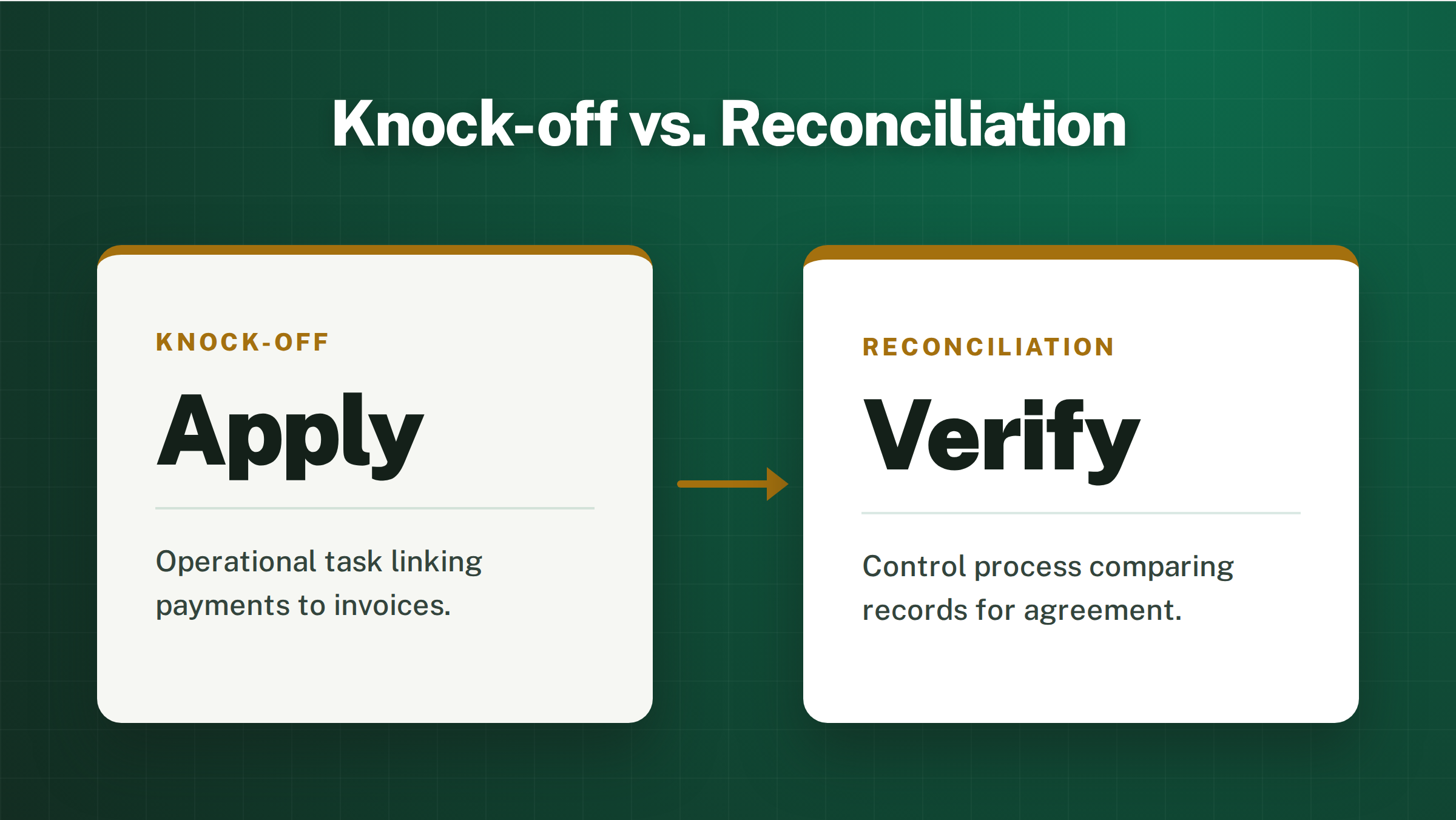
Knock-off and reconciliation are related but distinct processes. Knock-off is the specific action of applying a payment to an invoice (an operational task). Reconciliation is a broader control process of comparing two sets of records to ensure they agree (e.g., comparing your accounts receivable ledger to the general ledger, or your bank statement to your cash book). A proper knock-off is a prerequisite for an accurate reconciliation.
Sources & References
This article draws on research and data from the following verified sources:
From reading to seeing.
Every idea on this page runs live in a working collections desk. Bring your aging report and watch.
Book the working sessionKEEP READING