
Most overdue freight invoices are not a refusal to pay; they are a failure to approve. The invoice is sitting in the wrong inbox, is missing a proof of delivery, or has a disputed line item holding up the entire balance. Sending a formal dunning letter is overkill. What you need is a short, well-timed payment reminder message from someone the customer knows. But the same message that reads as helpful to a key account sounds weak to a chronic late payer. The words must change with the relationship.
This article gives you short, copy-ready payment reminder messages for WhatsApp and email. It splits them by timing—before, on, and after the due date—and by customer tier, with specific advice for freight forwarders in India, the UAE, the UK, and the US. For a complete overview of the collections process, see the complete guide to freight collections.
The short answer
A good payment reminder message is short, names the invoice, amount, and due date, and asks one clear question. Send one before the due date, one on it, and one after. The tone must change for key accounts, steady accounts, and chronic late payers. A helpful reminder prevents an invoice from becoming overdue; a firm reminder gets an overdue balance paid.
For a key account, the message is a courtesy check: "Can you confirm invoice [number] is scheduled for payment?" For a chronic late payer, it is a firm request: "Invoice [number] is now overdue. Please confirm payment by [date]." The best payment reminder is one that is read and acted on, so send it on the channel your customer's finance contact actually uses, whether that's email or WhatsApp.
What makes a reminder message work
An effective payment reminder isn't a demand; it's a piece of operational communication designed to get one result: payment approval. It works when it is short, specific, and asks a single, clear question from a person the customer trusts. Here is how to chase payment politely and effectively.
Keep it short: one screen on a phone
Your customer’s finance contact is busy. The reminder must be scannable on a phone screen. Put the critical information first: invoice number, amount, and due date. The entire message should be readable without scrolling. The subject line of a payment reminder email should be equally direct: "Payment reminder: Invoice [number] due [date]".
Be specific: name the debt
A vague reminder is an ignored reminder. To be actionable, your message must include:
- Invoice number: [invoice number]
- Amount and currency: [currency] [amount]
- Due date: [due date]
- Shipment reference: [MAWB, HBL or job number]
For international freight, always state the currency. A balance of "8,240" is ambiguous; "USD 8,240.00" is not.
Ask one clear question
Don't combine multiple requests. Your goal is to get a single, actionable answer. Focus on one of these two questions:
- Before the due date: "Is this payment scheduled?"
- After the due date: "When can we expect payment?"
This forces a concrete response—a date—which you can then track. "Please arrange payment" is a weak request; "What payment date can you confirm?" is a strong one.
Send it from a named person on the right channel
A message from "accounts@forwarder.com" is easy to ignore. A message from a named person the customer has dealt with before gets a response. Use the channel the customer's payment contact actually reads, whether that's email or a one-to-one WhatsApp message. According to WhatsApp’s Business Messaging Policy, a business may only contact people who have given it their number and opted in to hear from it, so confirm and record that consent.
Attach or link the necessary documents
A missing document is one of the commonest reasons an invoice sits unpaid. Pre-empt this by attaching the invoice and statement of account to your email. In the message, offer to resend the proof of delivery (POD), rate confirmation, or customs documents. This removes friction and shows you are trying to help, not just demand.
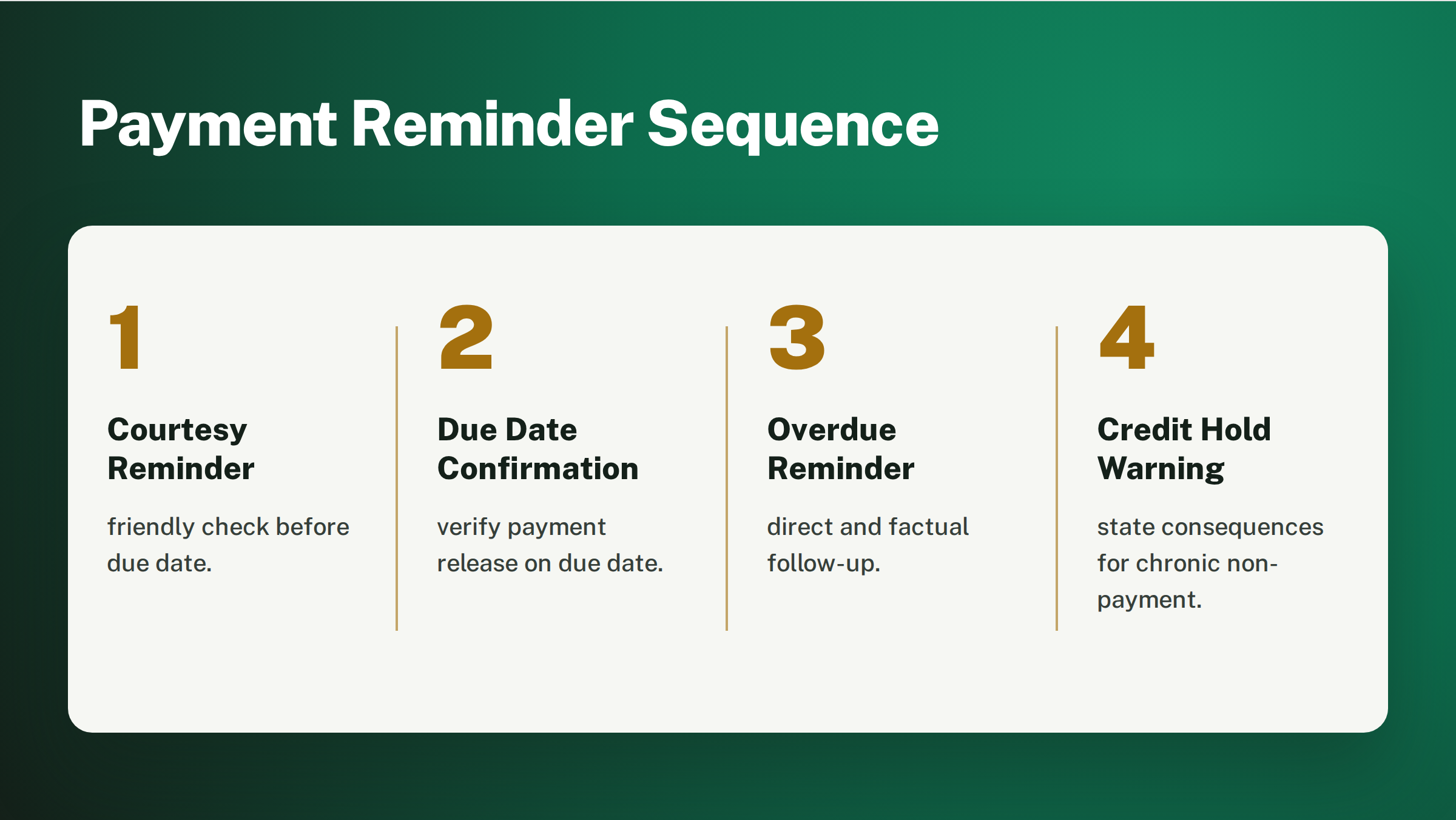
Before the due date: a courtesy reminder
The goal of a reminder sent before the due date is to prevent a missed payment. The tone is a helpful courtesy, not a demand. It confirms the invoice is in the customer's system and approved.
Tier 1: Key Account (Helpful & relationship-focused)
WhatsApp:
Hi [Name], a quick courtesy check on invoice [number] for [shipment ref], [currency] [amount], due [date]. Is it all approved for payment, or does your team need the invoice or POD resent?
Email:
Subject: Quick check on invoice [number] due [date]
Hi [Name],
Please could you confirm if invoice [number] for [currency] [amount] is approved and scheduled for payment on [date]? If your AP team needs the invoice, POD, or statement resent, I'll send it immediately.
Thank you, [Your Name]
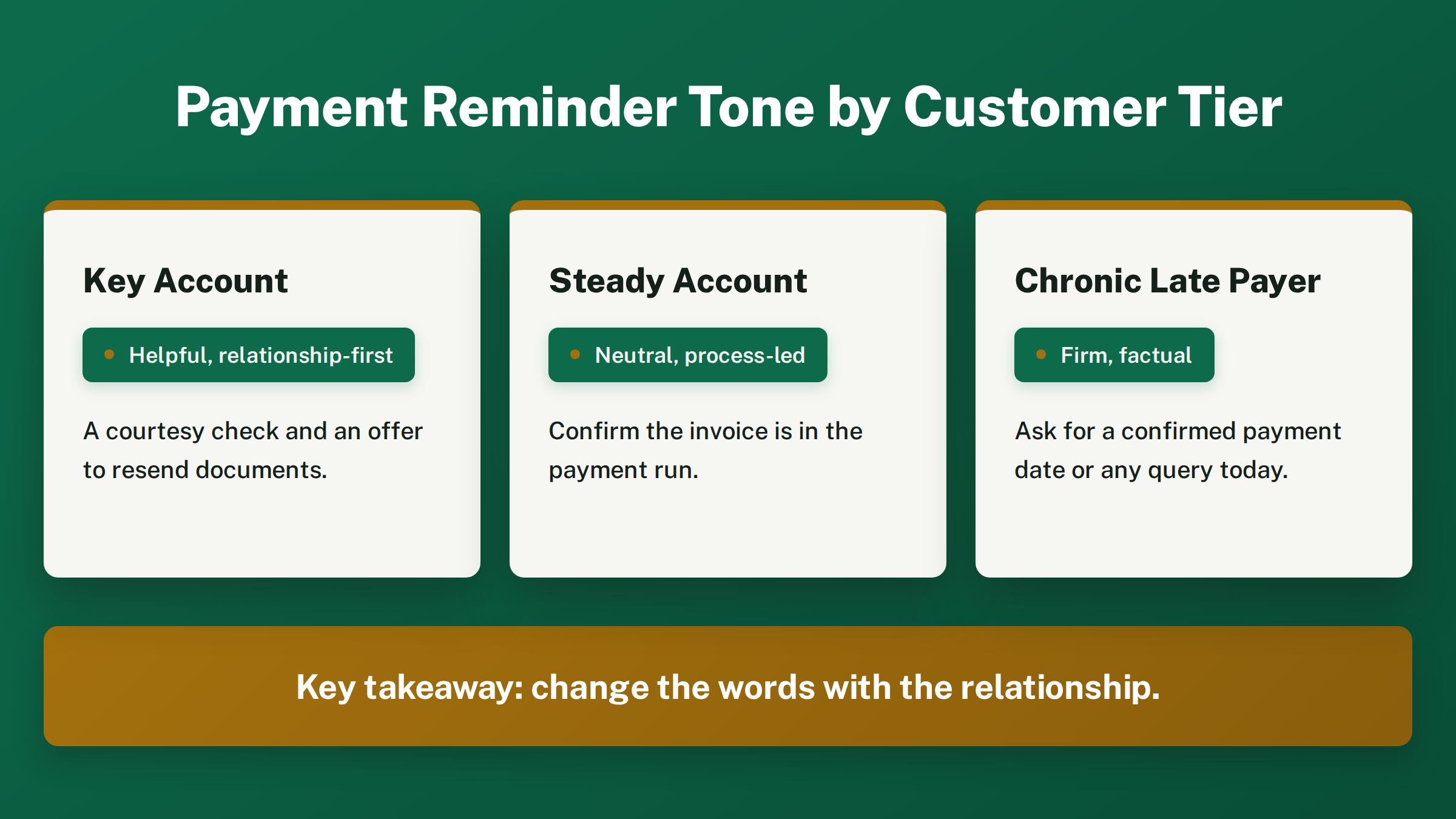
Tier 2: Steady Account (Neutral & process-led)
WhatsApp:
Hi [Name], invoice [number] for [currency] [amount] is due on [date]. Can you confirm it's in your payment run? Invoice and bank details are in the email I just sent.
Email:
Subject: Invoice [number] - payment scheduled for [date]?
Hi [Name],
Our records show invoice [number] for [currency] [amount] is due on [date]. Please confirm the date your finance team will release payment. If there's an issue, please let me know.
Regards, [Your Name]
Tier 3: Chronic Late Payer (Firm & factual)
WhatsApp:
Hi [Name], a reminder that invoice [number] for [currency] [amount] is due on [date]. Please confirm it will be paid on time or tell us today if there is any query holding it up.
Email:
Subject: Payment confirmation for invoice [number] due [date]
Hi [Name],
As invoice [number] for [currency] [amount] is due on [date], could you please confirm the planned payment date? If the invoice is under review, please contact us today so we can assist before the due date.
Regards, [Your Name]
On the due date: a confirmation request
On the due date, the message shifts from a courtesy check to a confirmation request. The objective is to confirm the payment has been released and to ask for the remittance advice.
Tier 1: Key Account (Friendly confirmation)
WhatsApp:
Hi [Name], just confirming payment for invoice [number] ([currency] [amount]) is going out today? Please share the remittance advice when it's processed. Thanks!
Email:
Subject: Payment due today - invoice [number]
Hi [Name],
Invoice [number] for [currency] [amount] is due for payment today. Could you please confirm it has been released? Once paid, please send the remittance advice so we can match it promptly.
Regards, [Your Name]
Tier 2: Steady Account (Operational follow-up)
WhatsApp:
Hi [Name], checking on today's due payment for invoice [number], [currency] [amount]. Has it gone out, or is anything holding it up? I can resend the invoice or POD immediately.
Email:
Subject: Action requested: Invoice [number] due today
Hi [Name],
A quick check on invoice [number] for [currency] [amount], due today. Has payment been released, or is any document or approval still required? Please reply with the status; if paid, please share the remittance advice.
Regards, [Your Name]
Tier 3: Chronic Late Payer (Finance-led & specific)
For customers in India who deduct tax at source (TDS) from freight payments, be exact: quoting the amount you expect after TDS stops the short receipt being mistaken for a short payment.
WhatsApp:
Hi [Name], invoice [number] for ₹[gross] is due today. Expected remittance after TDS is ₹[net]. Has payment gone out? Please share UTR and TDS details after payment.
Email:
Subject: Due today: Invoice [number] - remittance & TDS confirmation
Hi [Name],
Invoice [number] for ₹[gross invoice value] is due today. For our reconciliation, the expected remittance is ₹[net amount after TDS]. Please confirm payment has been released and send the UTR/remittance advice and TDS details.
Regards, [Your Name]

After the due date: an overdue payment reminder
Once an invoice is overdue, the tone must become firmer. The goal is to get a committed payment date and understand any blocking issues. This is the final step before escalating to formal dunning letter templates by tier.
Tier 1: Key Account (A colleague's check-in)
The message should come from the account manager, not just accounts. It's a relationship-preserving check-in to solve a problem.
WhatsApp:
Hi [Name], it's [Account Manager Name]. I'm checking on invoice [number] which was due [date]. Could you confirm it reached the right AP contact, or let me know if you need any documents resent? I'll coordinate with our finance team.
Email:
Subject: Quick check on invoice [number]
Hi [Name],
I’m checking in regarding invoice [number] for [currency] [amount], which was due on [date]. Could you confirm the invoice is with the correct accounts payable contact? If anything is missing, please let me know and I will arrange it.
Best, [Account Manager Name]
Tier 2: Steady Account (Terms quoted, date requested)
Reference the agreed terms and ask for a specific date. "Please pay soon" is not useful; "Please confirm payment by [date]" is.
WhatsApp:
Hi [Name], invoice [number] for [currency] [amount] was due on [date] under our agreed [30-day] terms. Please confirm the payment date, ideally by [requested date], or let me know today if there is a query.
Email:
Subject: Payment date requested - invoice [number] overdue
Hi [Name],
Invoice [number] for [currency] [amount] fell due on [date] under our agreed [30-day] payment terms and remains outstanding. Please confirm the date on which payment will be released. If payment has been made, please send the remittance advice.
Regards, [Your Name]
Tier 3: Chronic Late Payer (Clear date and consequence)
This late payment reminder must be unambiguous. State the deadline and the consequence you will actually apply, such as a credit hold on new bookings.
WhatsApp:
Hi [Name], invoice [number] for [currency] [amount] is now [X] days overdue. Please arrange payment by [specific date]. If not received, we will need to apply the agreed credit hold to new bookings as per our terms.
Email:
Subject: FINAL REMINDER: Overdue invoice [number] - payment required by [date]
Hi [Name],
Invoice [number] for [currency] [amount] was due on [date] and is now seriously overdue. Please ensure cleared funds reach us by [date]. If payment is not received, we will place the account on credit hold for all new bookings, effective [date], as per our credit policy.
Regards, [Credit Control Manager]
WhatsApp or email: which to use
The best channel is the one your customer's payment contact reads and responds to. However, each has a distinct role in the freight invoice collection process.
When to use WhatsApp
Use WhatsApp for a quick, personal nudge to a known contact who has opted in. It's ideal for a short status check or a confirmation request. However, WhatsApp’s policies prohibit sharing sensitive identifiers like full bank account numbers, so direct customers to a secure portal or email for payment details. Remember, you must have documented consent to contact a customer on WhatsApp for business purposes.
When to use email
Email is the channel for the formal record. Use it to send the invoice, statement of account, POD, and other supporting documents. It creates a searchable thread that can be forwarded to AP departments and serves as an audit trail for disputes or escalations. A payment reminder email is the default for any official communication.
Log every message
Regardless of the channel, every communication must be logged in your central system (TMS, CRM, or finance platform). This creates a single source of truth for your AR ageing report, tracks every promise to pay, and ensures your team knows the exact status of every invoice. Without this, you are chasing in the dark.
Mistakes that make reminders backfire
A poorly executed payment reminder message can do more harm than good, damaging relationships and creating unnecessary work.
Reminding about an invoice already paid
This is the cardinal sin of collections. It happens when a customer makes a lump-sum payment that hasn't been fully allocated. Before sending any reminder, ensure your team is correctly applying lump-sum payments to invoices. Chasing a paid invoice signals poor internal controls.
Chasing while a dispute is open
Sending an automated overdue payment reminder for an invoice with a genuine dispute (e.g., over detention and demurrage charges) is a fast way to alienate a customer. Pause chasing on the disputed amount, resolve the dispute, and chase only the undisputed balance in the meantime.
Sending the same wording to every customer
A one-size-fits-all approach is inefficient. A key account requires a soft touch; a chronic late payer needs a firm hand. Using the same template for both either offends your best customers or shows weakness to your worst.
Messaging outside the customer's working hours
A WhatsApp reminder sent at 2 AM in the customer's time zone is intrusive. Schedule messages for their local business hours. Respecting time zones for customers in India, the UAE, the UK, and the US shows professionalism.
Where Receivables AI fits
Manually tracking due dates, promises, and customer tiers across hundreds of invoices is where spreadsheets and email fail. This is where a dedicated system for freight collections works alongside your TMS. Forwarders are banks that do not charge interest; collections is where that cash comes back.
Receivables AI, built on FreighAI, takes the repetitive tracking out of collections so your team can spend its time on the conversations that need a person. It works by:
- Setting the tone of each payment reminder to the customer. Warmer for a key account, firmer for a chronic late payer.
- Tracking every promise to pay. It follows up when a promised date slips.
- Moving customers between tiers on its own. Based on how they actually pay, the system can update a customer's tier, ensuring the right level of pressure is applied.
- Keeping your team in control. A person approves every message written to a customer before it goes out in their own name. The rules and timing for reminders are set by your head of operations, and reminders can be switched off for any customer.
To see freight collections compared with generic AR tools or to understand how the desk works, start with those two pages.
Your team keeps the relationship and the approval; the desk keeps track of the reminders and the promises. When you're ready to see it in action, bring your AR aging report to a demo and we'll show you how much cash is stuck.
Frequently Asked Questions
How do I write a polite payment reminder message?
A polite payment reminder message is short, specific, and helpful. Start with a friendly greeting, clearly state the invoice number, amount, and due date. Frame it as a courtesy check, not a demand. Ask a simple question like, "Could you please confirm this is scheduled for payment?" and offer to resend the invoice or any supporting documents. Always send it from a named person the customer knows.
When should I send a payment reminder?
Send three: a courtesy reminder before the due date so it is not missed, a confirmation request on the due date to check that payment has been released, and an overdue payment reminder soon after it, getting firmer with each follow-up. Set the exact timing to your own terms and credit policy.
Is it acceptable to send payment reminders on WhatsApp?
Yes, it is acceptable for a known business contact who uses WhatsApp and has given you permission (opt-in). Use it for short, one-to-one nudges about a specific invoice. According to WhatsApp's Business Policy, you must not request sensitive financial data like full bank account numbers in a message. Keep it concise and direct the customer to email or a secure portal for documents and payment.
What should a late payment reminder say?
A late payment reminder should be direct and factual. It must state the invoice number, the amount, the original due date, and how many days it is overdue. Ask for a specific payment date with a question like, "The invoice is now [X] days overdue. When can we expect payment?" For chronically late customers, you should also state the consequence of continued non-payment, such as a credit hold, as defined in your terms.
How does Receivables AI adapt reminders for different customers?
It sets the tone of each payment reminder to the customer: warmer for a key account, and firmer for a chronic late payer. The system can move customers between these tiers automatically from how they actually pay. Every message is still approved by a person on your team before it's sent.
Sources & References
Sources:
From reading to seeing.
Every idea on this page runs live in a working collections desk. Bring your aging report and watch.
Book the working sessionKEEP READING