
A promise to pay is a customer's commitment to pay a stated amount against stated invoices by a stated date. For a freight forwarder, the routine is simple: log it the moment it is made, confirm it in writing, pause reminders on those invoices until the date, and follow up the day it slips. This turns a vague assurance into a concrete payment commitment your accounts receivable (AR) team can track and enforce.
This article is a practical tutorial for B2B freight collections; consumer debt and household bill arrangements work differently. We explain how to build a simple, repeatable process for every promise to pay, turning a common source of collection leakage into a point of AR discipline. For a complete overview of the collections process, see the complete guide to freight collections.
What a promise to pay means in B2B collections
In freight invoice collection, a promise to pay is a specific commitment from a customer’s payment contact. It’s a signal that an invoice has been seen, processed, and scheduled for payment. It is the most useful thing a collector can hear, but it is often lost in a one-line email reply or a quick phone call.
The Four Parts of a Good Promise
A vague statement like "we'll pay next week" is a prompt for a follow-up question, not a finished promise to pay. A useful, actionable payment commitment has four distinct parts:
- Who promised: The name, title, and company of the person making the commitment.
- The amount: The exact amount and currency (e.g., USD 14,500, not "the outstanding balance").
- Which invoices: The specific invoice numbers the payment will cover.
- The date: A specific calendar date when the payment will be made or arrive.
Capturing these four elements turns an informal comment into a structured record.
Not a Formal Legal Instrument
It is important to understand the promise to pay meaning in this context. It is an operational tool for credit control, not a formal promissory note or a new legal contract. Its job is to run your follow-up and make your cash forecast more honest: it tells you what to do next and when.
How to log a promise to pay
Discipline starts with process. Every promise to pay should be recorded the moment it is made, against the specific invoices it covers—not just as a free-text note on the customer’s account. This creates an auditable trail and ensures anyone on the finance team can see the exact status of an invoice.
Essential Fields for Your Log
Whether you use a spreadsheet, your TMS, or a dedicated collections tool, your log for each promise should include these fields:
- Date made: When the promise was received.
- Who made it: The customer contact’s name and role.
- Channel: How it was made (email, call, WhatsApp, portal).
- Amount and currency: The exact figure promised.
- Invoice numbers: The specific invoices covered by the promise.
- Promised date: The date the customer committed to pay.
- Status: A controlled field, such as Open, Kept, Part-Kept, or Broken.
Handling Part Payments
Customers often promise to pay part of an invoice or a group of invoices. Log exactly what was promised against what is outstanding. If a customer promises USD 5,000 against a USD 12,000 invoice, your log should show the USD 7,000 balance remains open and subject to your normal collection cycle.
India: Note TDS Deduction Explicitly
For collections in India, a common point of friction is Tax Deducted at Source (TDS). A short receipt may not be a broken promise if the customer has deducted TDS correctly. To avoid confusion, your log must note whether the promised amount is before or after TDS deduction.
If the customer pays less than the invoice because it has deducted TDS, record the difference as a pending TDS item, not a short payment, and ask for the TDS certificate so the account can be reconciled.
Hold reminders until the promised date
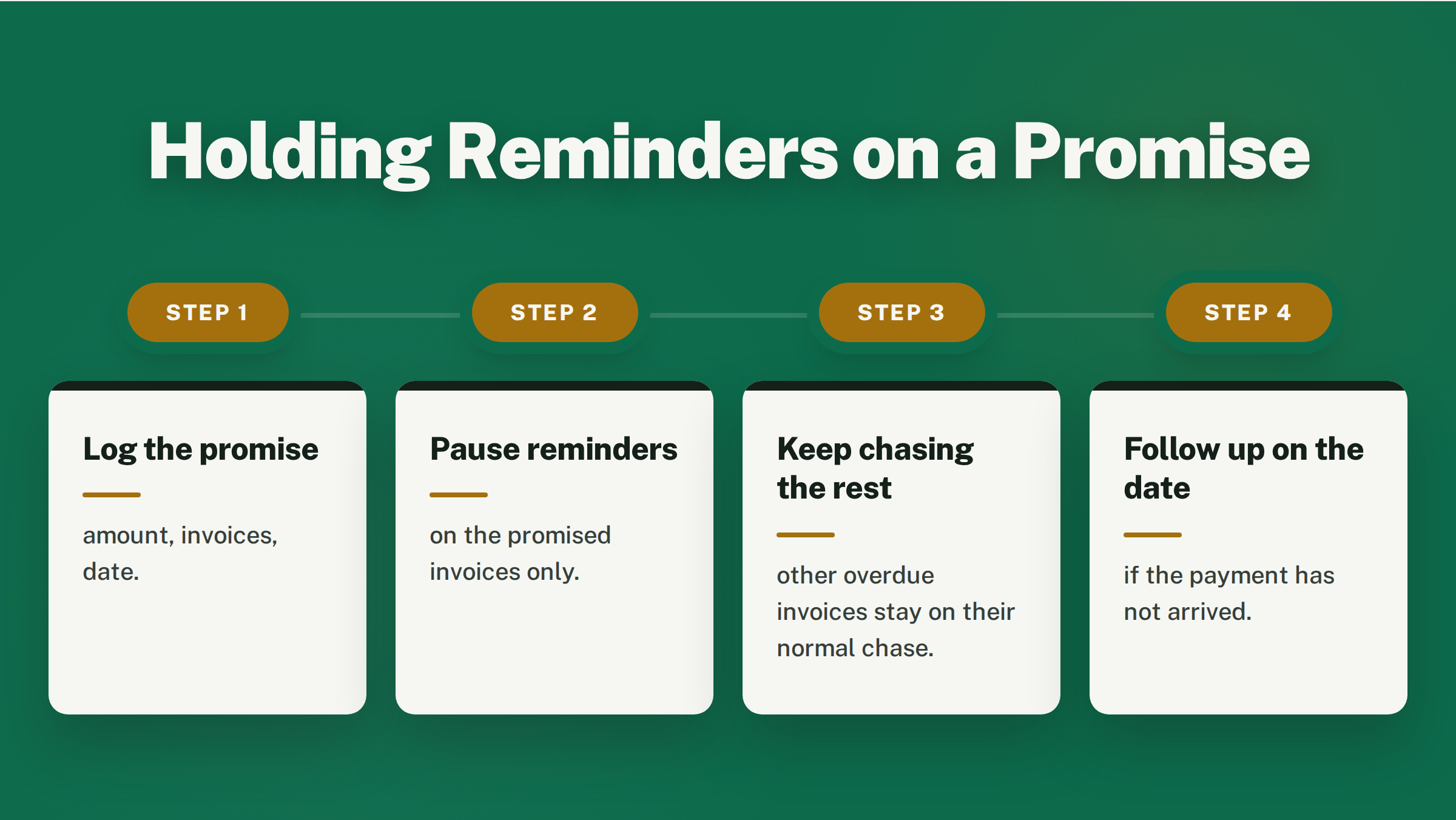
Once a customer commits to a payment date, your system should honour it. Continuing to send automated reminders for an invoice that has a promise to pay attached makes your collections desk look disorganised and can damage the customer relationship. It signals that you weren't listening.
Pause Reminders on Promised Invoices Only
The key is precision. The hold on reminders should apply only to the specific invoices covered by the promise. Other overdue invoices for that same customer must continue through their normal dunning workflow.
Example: A customer has three overdue invoices. They promise to pay Invoice A next Friday. Your system should pause reminders for Invoice A until next Friday but continue chasing Invoices B and C according to your standard schedule.
This maintains collection pressure on the overall debt while respecting the specific agreement you made.
Keep Invoices Visible in the Aging Report
Pausing reminders does not mean the invoice disappears. It must remain visible in your accounts receivable aging report, sitting in its correct ageing bucket (for example, 31–60 days). The promise is a workflow flag, not a payment. It changes the next action, but it doesn't change the fact that the cash is still outstanding. This ensures your DSO (Days Sales Outstanding) and cash flow forecasts remain accurate.
Confirm the promise in writing: a short template
After a customer gives a verbal promise on a call, confirm it immediately in writing. This isn't an aggressive demand; it's a professional courtesy that creates a clear, shared record and prevents misunderstandings. A simple confirmation email or chat message solidifies the commitment.
Why a Written Confirmation is Crucial
A written confirmation, often called a promise to pay letter (even if it's just an email), serves several purposes:
- Clarity: It ensures both you and the customer have the same understanding of the amount, invoices, and date.
- Accountability: It makes the promise more concrete and harder to forget or ignore.
- Evidence: It creates a documented trail that is invaluable if the promise is broken or a dispute arises later.
Email Confirmation Template
Keep the tone friendly and professional. This is a record of an agreement, not a demand letter.
Subject: Following up on our call – Payment Confirmation
Hi [Customer Name],
Thanks for your time on the phone today.
Just to confirm our conversation, you will arrange for a payment of [Amount and Currency] by [Promised Date] to cover the following invoices:
- Invoice [Number] - [Amount]
- Invoice [Number] - [Amount]
Please let me know if any of this is incorrect. We appreciate your partnership.
Best regards,
[Your Name]
Credit Control, [Your Company]
One-Line Chat Confirmation (WhatsApp/Teams)
For less formal channels, a quick confirmation works just as well.
"Thanks [Name] – just confirming you'll pay [Amount] on [Date] for invoices [Numbers]. Let me know if that's not right!"
When a promise is broken
The real test of your AR discipline is what happens the day after a promise to pay is missed. A week’s delay in following up tells the customer that your deadlines are flexible and that paying you can be deferred. Swift, consistent action is critical.
Follow Up Immediately
Your process should trigger a follow-up on the promised date or the very next working day. Do not wait. The first contact can be a polite check.
- First Broken Promise: Send a polite message or call. "Hi [Name], just checking on the payment for [Amount] we expected yesterday. Can you confirm if it has been sent and provide the remittance advice?" The goal is to understand the reason for the delay and secure a new, firm date.
- Repeated Broken Promises: The approach must become firmer. This is where a person calls, not just an automated email. Escalate the contact to a more senior person on your team and theirs.
State Consequences You Will Apply
For customers who repeatedly break promises, you must introduce consequences. However, only state consequences you are actually prepared to enforce, such as placing the account on credit hold for new bookings. Empty threats destroy your credibility. For more formal escalation steps, you can adapt our library of dunning letter templates.
What promise history tells you about a customer
Over time, a customer’s record of kept and broken promises is one of the clearest indicators of their true payment behaviour and financial health. This data is far more valuable than their contractual payment terms. It tells you how they actually pay, not how they are supposed to pay.
A Signal for Your Credit Control Process
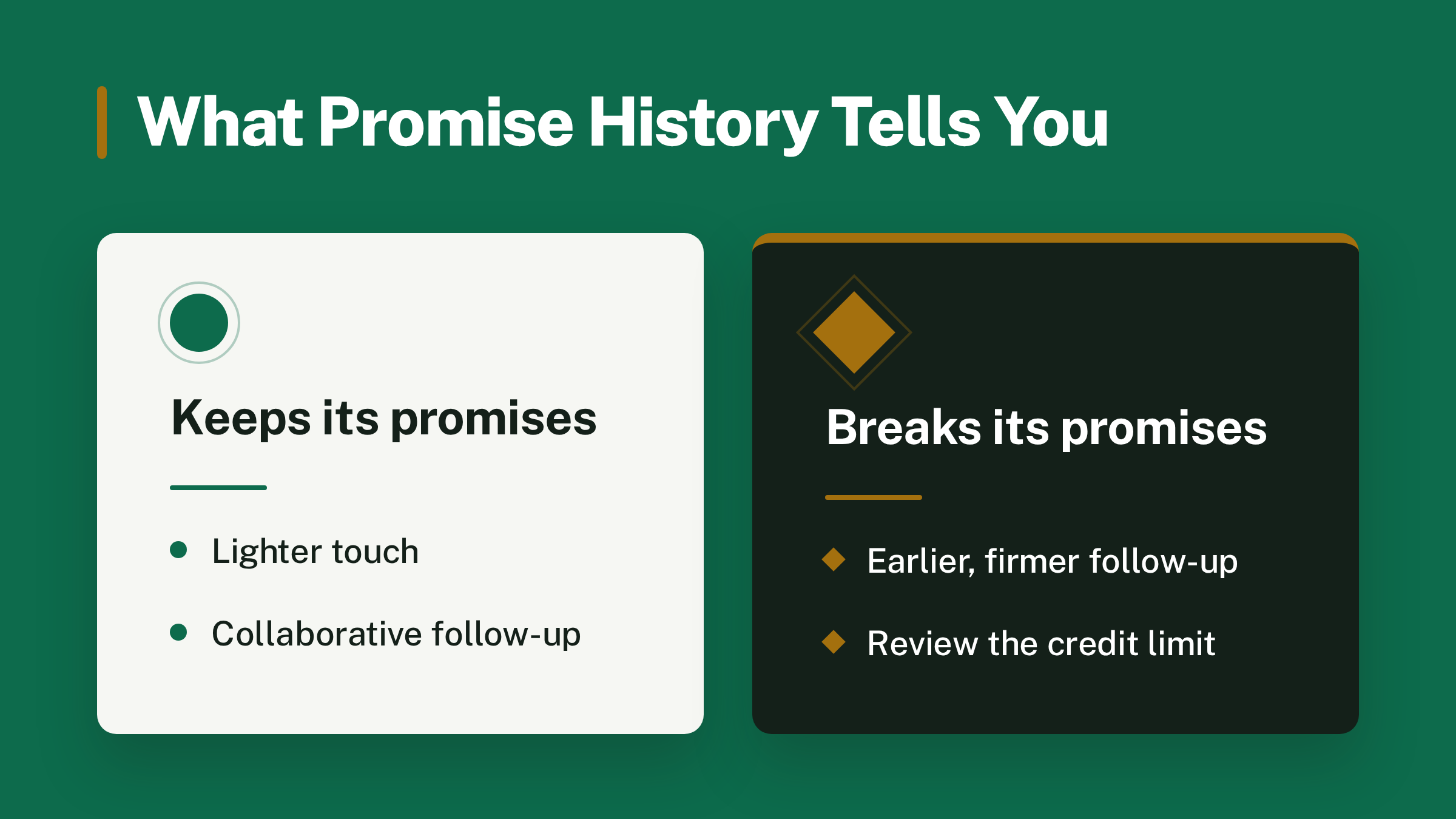
Use this history to segment your customers and tailor your collection strategy:
- Always Keeps Promises: These customers, even if they need extended terms, are reliable. They require a lighter touch and more collaborative communication. This is especially important when chasing key accounts without burning them.
- Frequently Breaks Promises: These customers pose a higher credit risk. They require earlier, firmer, and more frequent follow-ups. Their credit limits should be reviewed more often, and you might consider moving them to more restrictive terms like cash-before-release for new shipments.
This behavioural data should be a key input when setting and reviewing credit limits within your credit control process.
Promises made inside a dispute
It is common in freight for a customer to promise to pay the undisputed portion of an invoice while a specific charge, like detention or demurrage, is under review. This is a positive signal, but it requires careful handling in your system.
Log the Promise Against Undisputed Invoices Only
When a customer says, "We'll pay the freight, but we're disputing the detention on container X," you must split the workflow.
- Log the promise to pay only against the undisputed freight charges.
- Pause reminders for that specific amount until the promised date.
- Move the disputed charge into a separate workflow for resolution. Do not chase for it until the dispute is resolved.
This prevents you from chasing a customer for a charge they have a legitimate query on, which protects the relationship. It also ensures you collect the cash that is available now. This is a common issue with invoices blocked by detention and demurrage disputes. In the US, the Federal Maritime Commission’s rule on detention and demurrage billing gives billed parties at least 30 calendar days to ask for a waiver or refund, and the billing party then has 30 calendar days to try to resolve it, so a disputed charge can take a while to settle.
Where Receivables AI fits
Managing hundreds of promises manually across spreadsheets and email is where AR discipline breaks down. A collector gets busy, a promised date is forgotten, and cash that was committed is never collected. This is a problem that systems are built to solve.
Receivables AI, built on the FreighAI platform, provides the structure and automation needed to manage every promise to pay systematically. It works alongside your team to enforce the process described in this article.
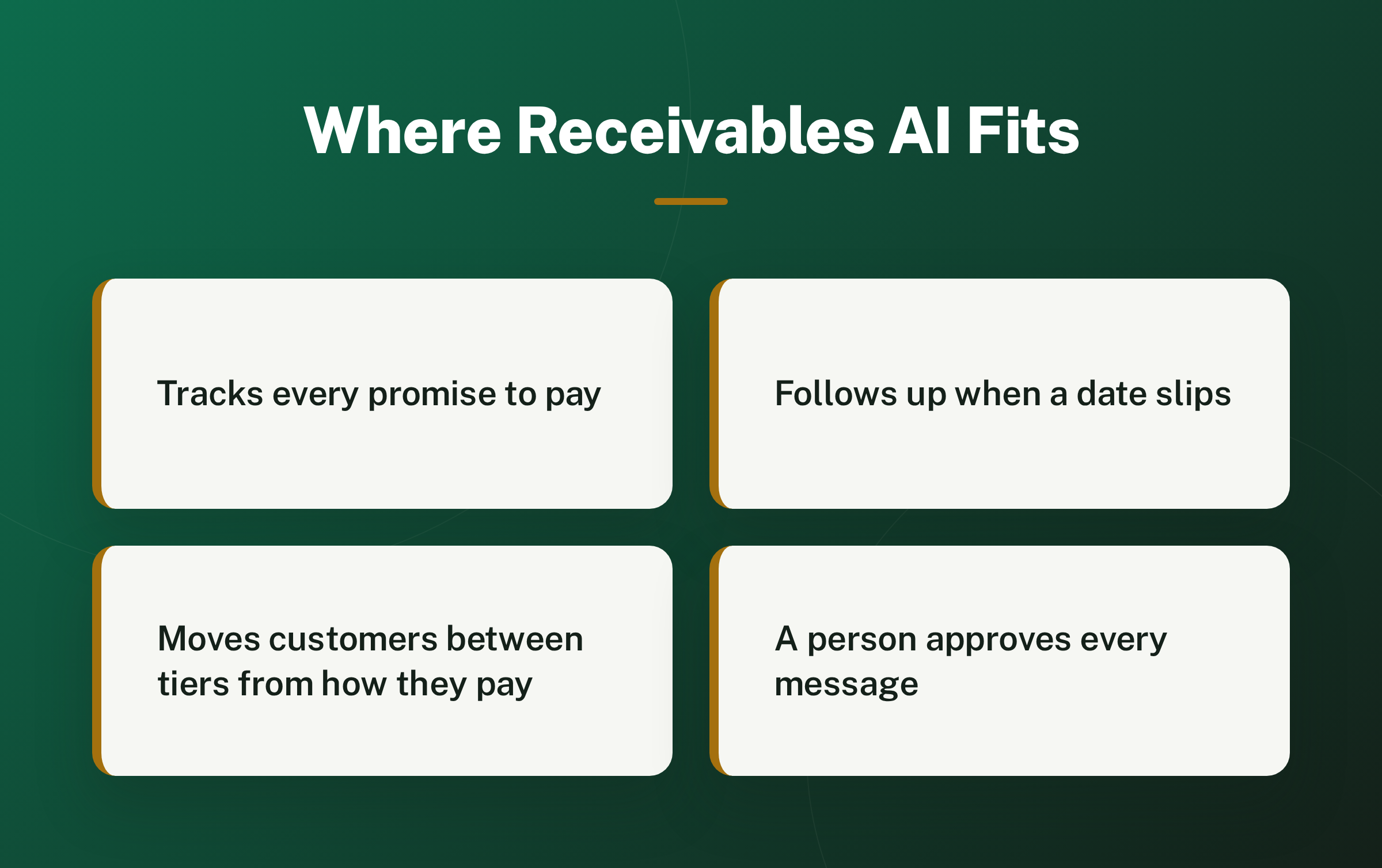
- It tracks every promise to pay and follows up when a promised date slips. No promised date passes unnoticed.
- It moves customers between tiers on its own, from how they actually pay. A customer who pays reliably is not chased like one who keeps paying late.
- It sets the tone of each payment reminder to the customer. Reminders can be warmer for a key account and firmer for a chronic late payer.
- A person approves every message written to a customer. The system suggests the follow-up, but an approved message goes out in your team member's own name, keeping the human connection.
This approach combines the relentless consistency of automation with the judgment of your experienced collectors. To see a detailed comparison, explore freight collections compared with generic AR tools or learn more about how the desk works.
Ready to see how much cash is stuck in your aging report? Bring your AR aging report to a demo and we'll show you how to get it flowing again.
Frequently Asked Questions
What does promise to pay mean?
In a business-to-business context, a promise to pay meaning refers to a customer's specific commitment to pay a stated amount, against stated invoices, by a stated date. It is an informal but important agreement captured during the collections process. It is not a formal legal instrument like a promissory note, but rather an operational tool to manage accounts receivable and forecast cash flow.
What should a promise to pay letter include?
A promise to pay letter, which is typically a confirmation email, should be simple and clear. It should include the total amount and currency promised, the specific invoice numbers the payment covers, and the exact date the payment will be made. It's also good practice to include a friendly line asking the customer to reply if any of the details are incorrect. This creates a clear, shared record for both parties.
Should reminders stop after a promise to pay?
Yes, but only for the specific invoices covered by the promise. Once a customer has committed to a payment date for certain invoices, you should pause automated reminders for those items until the promised date has passed. However, you should continue your normal dunning workflow for any other overdue invoices from that same customer that were not part of the promise.
What do you do when a customer breaks a promise to pay?
You should follow up immediately, on the promised date or the next working day. The first time a promise is broken, the follow-up can be a polite check to see if the payment was sent. If promises are broken repeatedly, the follow-up should become firmer, typically involving a phone call from a collector or finance manager. You may need to state clear consequences you will enforce, such as placing the account on a credit hold for new shipments.
Sources & References
Sources:
From reading to seeing.
Every idea on this page runs live in a working collections desk. Bring your aging report and watch.
Book the working sessionKEEP READING