
As a freight forwarder, you are a bank that doesn’t charge interest. You pay carriers in days and get paid by customers in months, making collections the engine that brings your working capital home. Your Days Sales Outstanding (DSO) is the single most important measure of how fast that engine is running. But if the inputs are wrong, the number is a lie. This article is about getting to a DSO number you can trust; for the wider picture, see the complete guide to freight collections.
The standard DSO formula is simple. The accounts receivable ledger it runs on is not. In freight forwarding, cash often arrives against a statement of account, not a single invoice. Customers in India deduct tax at source (TDS) before paying. And in the Gulf and India, a post-dated cheque (PDC) in your drawer is not money in your bank. Each of these habits distorts your DSO. This guide teaches the formula, then shows you how to clean the inputs so the result means what it says.
The DSO formula
Days Sales Outstanding (DSO) measures the average number of days it takes for a company to collect payment after a sale has been made. For a freight forwarder, it’s the time between invoicing a shipment and receiving the cash. A lower DSO means you get paid faster, improving your cash flow.
DSO Formula:
DSO = (Accounts Receivable at the end of the period ÷ Credit Sales for the period) × Number of days in the period
What each input means
To get a reliable number, you must define your inputs correctly. The standard DSO formula relies on three components:
- Accounts Receivable (AR): This is the total amount of money your customers owe you for invoiced services on a specific date. According to Boise State University Pressbooks, it represents unpaid amounts for goods or services supplied on credit. It’s your closing trade receivables balance.
- Credit Sales: This is the total value of invoices you raised on credit terms during the same period. It’s crucial to use credit sales only; cash sales don't create a receivable, so including them would artificially lower your DSO.
- Number of Days in the Period: This is the number of calendar days in the period you are measuring (e.g., 30 for September, 91 for Q3, 365 for a year). The period for AR and credit sales must be identical.
A quick example of the arithmetic
Let's say for the month of August 2026, a forwarder has:
- Closing Accounts Receivable on 31st August: $480,000
- Credit Sales invoiced in August: $1,200,000
- Days in August: 31
The calculation is: ($480,000 ÷ $1,200,000) × 31 = 12.4 days. This article will show a more complex, freight-specific example, but the basic arithmetic is the same. The key is ensuring the inputs are clean before you start. Learning how to calculate DSO is less about the math and more about the data hygiene.
Monthly, quarterly, and the countback method
You can calculate DSO over any period, but monthly and quarterly are the most common for management reporting. The method you choose affects the result, so consistency is critical. A DSO series is only useful if it is comparable period over period.
Monthly and quarterly DSO calculations
For a monthly DSO calculation formula, you can use 30 days as a convention or the actual calendar days in the month (e.g., 31 for January, 28 for February 2026). Using actual days is more precise. For a quarterly calculation, you use the total days in that quarter (e.g., 90, 91, or 92).
A potential issue with using the period-end AR balance is that it can be skewed by a large batch of invoices raised on the last day. To smooth this out, many finance teams use an average receivables balance.
Formula using Average AR:
DSO = ((Opening AR + Closing AR) ÷ 2) ÷ Credit Sales for the period × Number of days
This approach gives a more balanced view of the receivables across the period.
The countback method for seasonal businesses
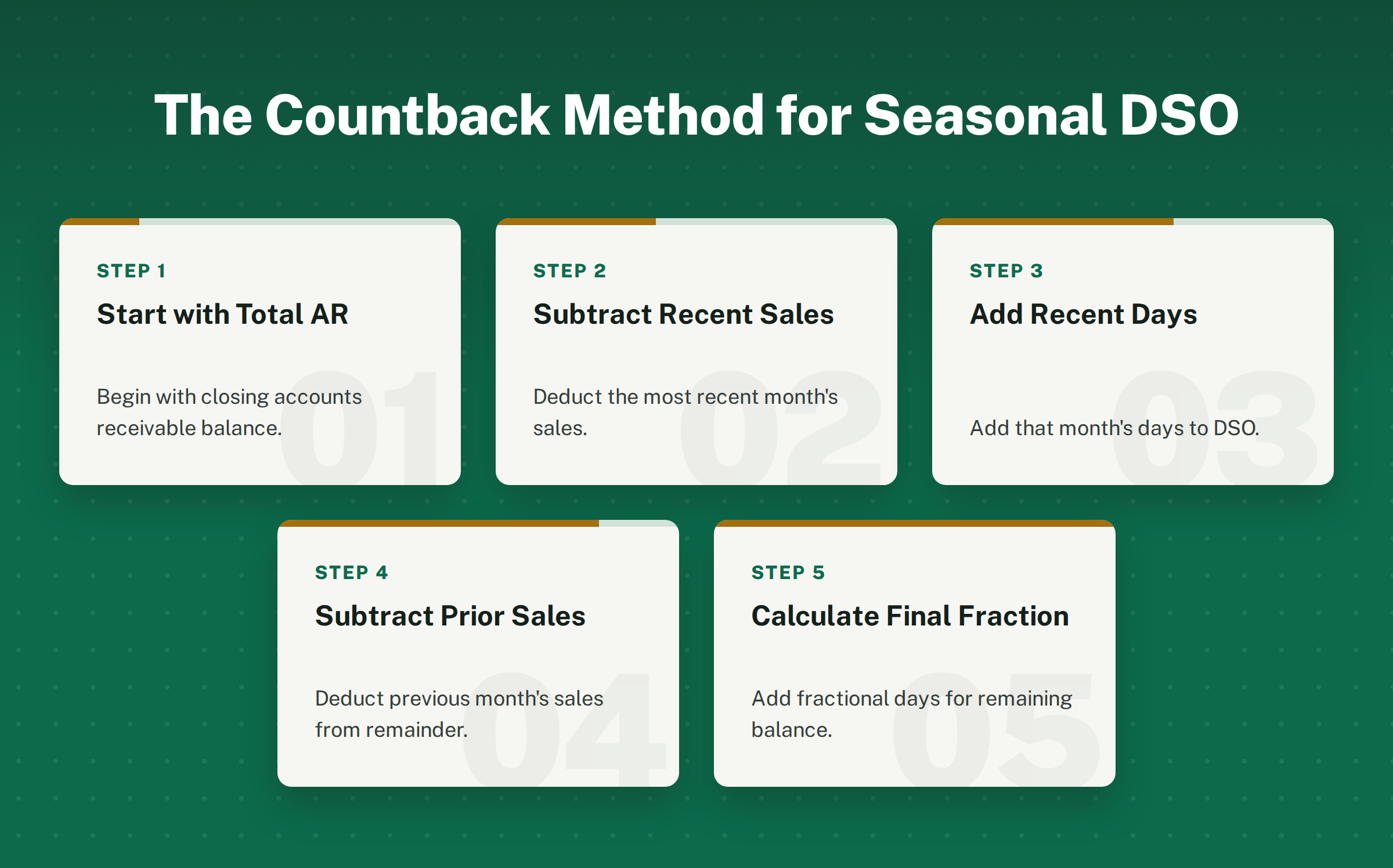
The countback method is an alternative days sales in receivables formula that works well for businesses with seasonal or fluctuating sales—a common scenario for freight forwarders with peak seasons. Instead of dividing AR by sales, you start with your closing AR balance and subtract the most recent month's credit sales, then the previous month's, and so on, until the AR balance is accounted for.
As described by Xero, the process is:
- Start with your total accounts receivable.
- Subtract the credit sales from the most recent full month. Add that month's days to your DSO.
- If there's still a receivable balance, subtract the prior month's sales.
- In the final month, calculate the portion of that month's sales that covers the remaining AR and add the corresponding fraction of days.
This method gives more weight to recent sales activity and is more accurate when sales are not stable month-to-month.
Pick one method and stick with it
Whether you use the standard formula with an ending or average balance, or the countback method, the most important rule is consistency. Comparing a DSO calculated with the average-balance method in one month to a countback DSO in the next is meaningless. As Oracle's documentation confirms, these are distinct calculation bases. Choose the method that best reflects your business rhythm and use it every time.
Three freight habits that distort DSO
The standard DSO formula assumes a clean ledger where each invoice is paid individually. In freight forwarding, payment practices are rarely that simple. Three common habits can significantly inflate or distort your reported DSO if not handled correctly.
1. Payment against a Statement of Account (SOA)
Many customers, especially larger ones, don't pay invoice by invoice. They pay a single lump sum against a monthly or weekly Statement of Account (SOA). Until your finance team allocates this lump sum to the specific invoices it covers, the cash sits as "unapplied" on the customer's account, and the individual invoices still appear as open and overdue.
This creates a major distortion: your bank balance is up, but your AR ledger makes it look like the customer hasn't paid. Your calculated DSO will be artificially high.
The Fix: Before you close the month, prioritize applying receipts to invoices. For reporting, you can present an adjusted DSO by subtracting verified, unapplied customer cash from your total receivables. The goal is to reflect the true economic exposure, not just what the system shows before reconciliation.
2. TDS short-payments (India)
In India, it is common for customers to deduct Tax Deducted at Source (TDS) from their payments to contractors, including freight forwarders. For services falling under Section 194C of the Income Tax Act, a customer might deduct 1% or 2% from your invoice and remit it directly to the government.
Your bank receipt will be for the invoice amount minus TDS, leaving a small residual balance on the invoice. If this residual is left in your trade receivables, it incorrectly inflates your AR balance and DSO. This amount is not an overdue customer debt; it is a tax credit you can claim.
The Fix: Once the customer provides a TDS certificate or the deduction appears in your Form 26AS or Annual Information Statement (AIS), the residual amount should be moved from trade receivables to a "TDS Receivable" or tax credit account. According to the Central Board of Direct Taxes, Form 16A is the certificate for TDS deductions. Your TDS receivable accounting process must track these amounts until they are confirmed and reclassified.
3. Post-Dated Cheques (PDCs)
In the UAE, the wider GCC, and India, receiving a post-dated cheque (PDC) is a common way to secure future payment. However, a cheque in your desk drawer is a promise to pay, not cash. The invoice remains legally outstanding until the cheque clears.
If you reduce your accounts receivable the moment you receive a PDC, you are understating your true credit exposure and your DSO. This can give a false sense of security about your cash position.
The Fix: Do not reduce your AR balance or DSO for PDCs in hand. Instead, maintain a separate PDC register for tracking and cash flow forecasting. The invoice should only be marked as paid when the cheque clears the bank. This is a critical part of managing post-dated cheques effectively. Report your receivables "covered by PDCs" as a separate, supplementary metric, but never as your primary DSO.
Worked example: a Mumbai forwarder's September 2026 DSO
Let's apply these principles to a practical scenario. Here are the figures for a freight forwarder in Mumbai for September 2026. We will calculate the raw DSO first, then the corrected DSO that gives a true picture of collection performance.
Inputs for the calculation
- Period: September 2026 (30 days)
- Credit Sales Invoiced in September: ₹4,20,00,000
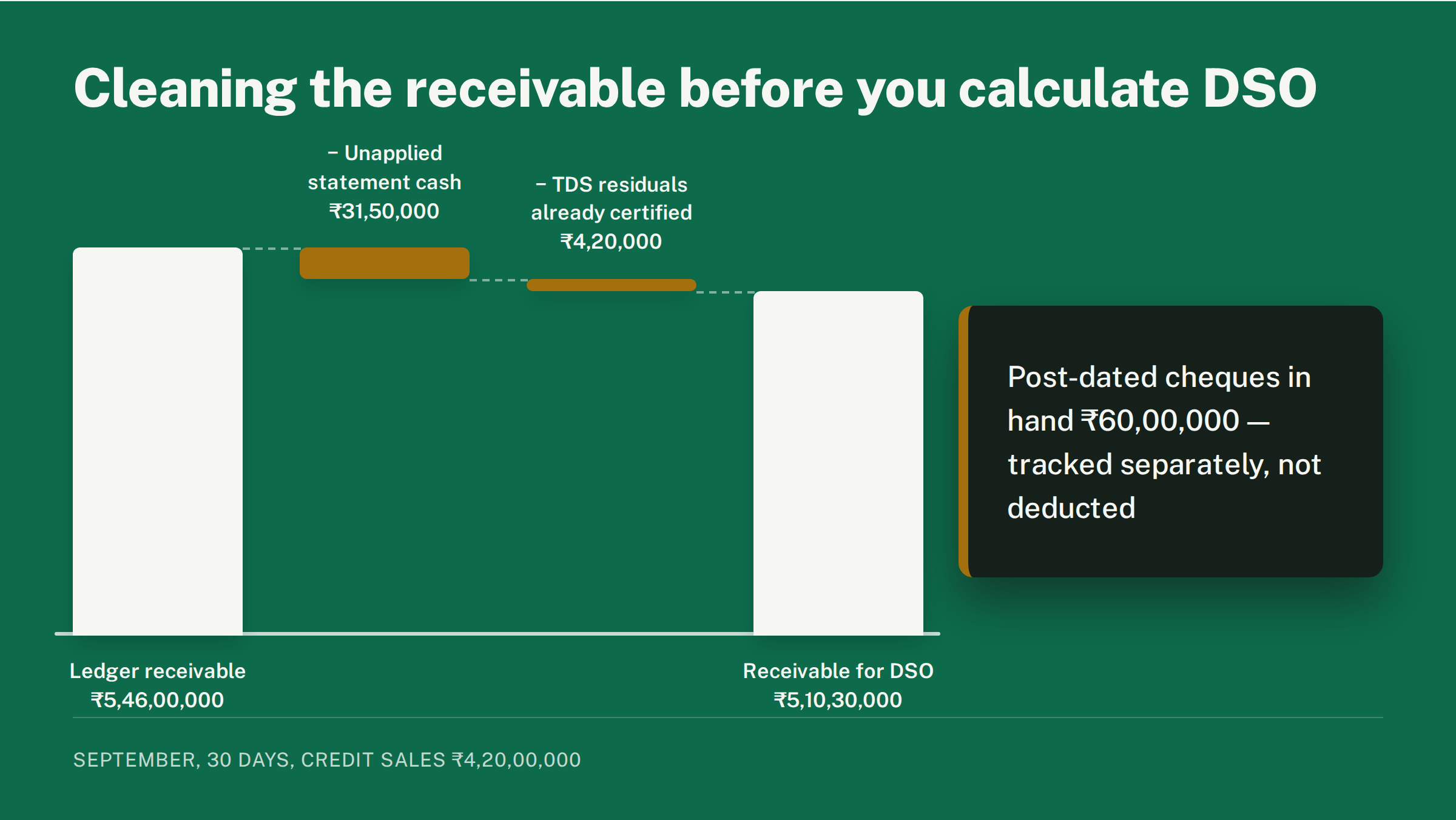
- Month-End Receivable Ledger (Gross Open Invoices): ₹5,46,00,000
- Unapplied Receipts on Customer Accounts: ₹31,50,000
- TDS Residuals on Invoices (visible in Form 26AS): ₹4,20,000
- Post-Dated Cheques in Hand (not yet cleared): ₹60,00,000
Step 1: Raw DSO from the unadjusted ledger
First, let's calculate the DSO using only the gross figures from the accounting system, without any adjustments. This is the number many companies report, and it is misleading.
- Receivables: ₹5,46,00,000
- Credit Sales: ₹4,20,00,000
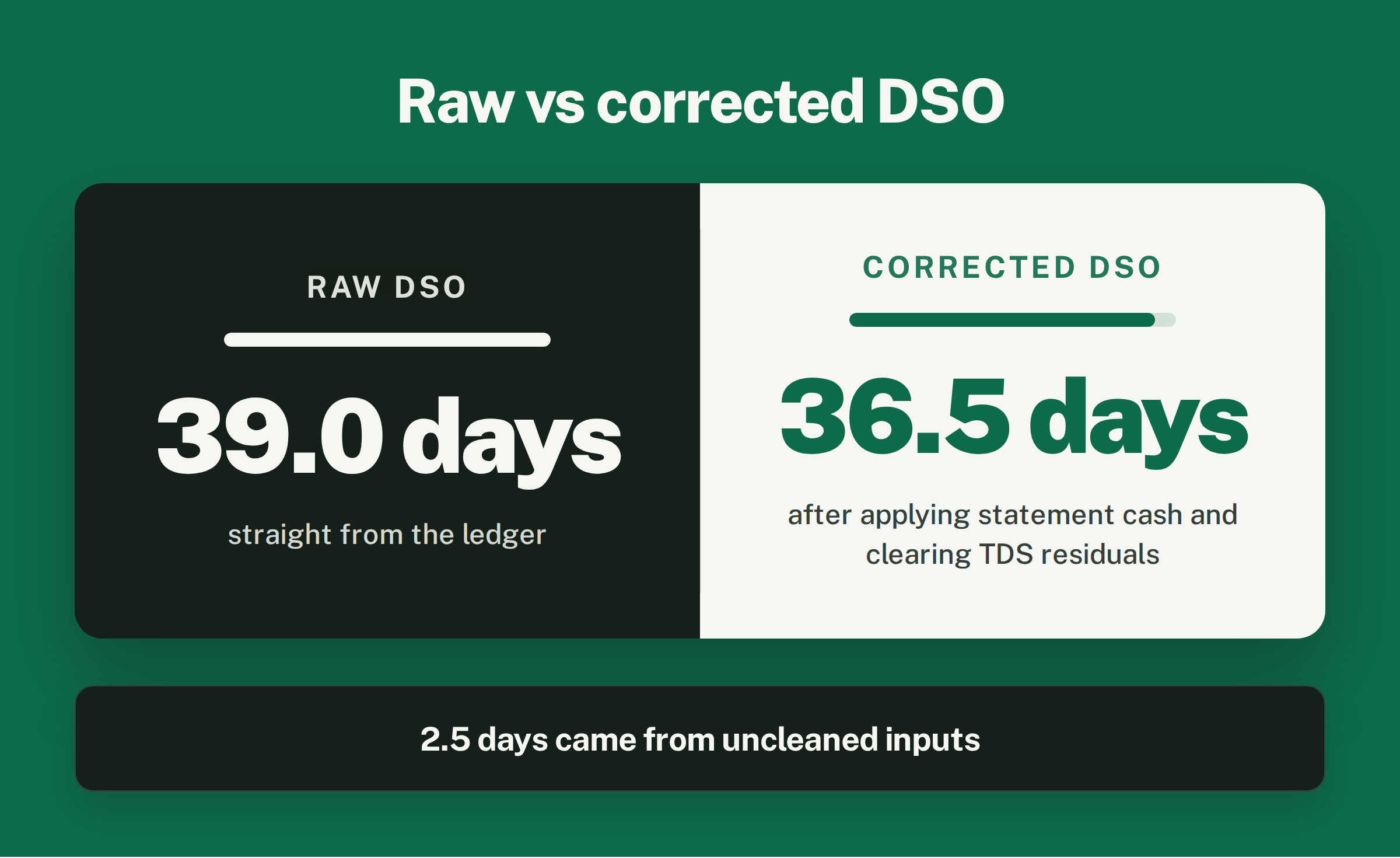
Raw DSO Formula: (₹5,46,00,000 ÷ ₹4,20,00,000) × 30 days = 39.0 days
This figure suggests it takes 39 days to collect payment. But it ignores cash already in the bank and tax credits already secured.
Step 2: Adjusted DSO after cleaning the inputs
Now, let's adjust the receivables balance to reflect the true amount outstanding from customers. We subtract the unapplied cash and the confirmed TDS residuals. We do not subtract the PDCs.
Adjusted Receivables: ₹5,46,00,000 (Gross AR) - ₹31,50,000 (Unapplied Cash) - ₹4,20,000 (TDS Credit) = ₹5,10,30,000
Now we use this cleaned-up number in our DSO formula:
Corrected DSO Formula: (₹5,10,30,000 ÷ ₹4,20,00,000) × 30 days = 36.5 days
The corrected DSO is 36.5 days. This is the number to report to management and lenders. It accurately reflects the 2.5-day improvement hidden by poor data hygiene.
Step 3: A separate 'covered' view for cash planning
The ₹60,00,000 in PDCs is not collected cash, but it is an important indicator for cash flow forecasting. You can report it separately:
- Corrected DSO: 36.5 days
- Net Receivables: ₹5,10,30,000
- Receivables Covered by PDCs: ₹60,00,000 (11.8% of net receivables)
This gives a complete picture: the true collection performance (DSO), the outstanding collectible amount, and the portion of that amount secured by a future-dated payment instrument. After seeing the impact, you can see how much cash is stuck in your own receivables.
Cleaning the inputs every month
A trustworthy DSO requires a disciplined month-end closing process. Your goal is to ensure the numbers you pull from your ledger reflect economic reality. Here are the essential steps for your finance and credit control team.
1. Apply statement receipts to invoices
Before you run your month-end AR ageing report, your team must allocate all received cash. When a customer pays against a statement, use their remittance advice to knock off the corresponding invoices. If no advice is provided, contact the customer immediately. Leaving cash unapplied is the single biggest cause of inflated DSO.
2. Reclassify confirmed TDS residuals
For your Indian operations, run a monthly check of your Form 26AS or AIS through the Income Tax Department's portal. As confirmed by the Income Tax Department of India, these statements provide details on tax deducted by your clients. For every TDS amount that appears, ensure the corresponding residual on your invoice is moved from the customer's trade receivable account to your TDS receivable account. This is not a write-off; it's a reclassification from a customer debt to a tax asset.
3. Maintain a register of post-dated cheques
Your PDC register is a critical control tool. It should track the customer, cheque amount, cheque date, and expected deposit date. This register should be reviewed weekly to ensure cheques are deposited on time. The amounts in this register should remain in your AR ageing report until the cheques have cleared. Do not remove them from your receivables balance prematurely.
4. Use a consistent cut-off date
Your DSO calculation is a snapshot in time. To be accurate, the snapshot of your receivables and your sales must be taken on the exact same date. Close your sales ledger and your receivables ledger at midnight on the last day of the month. Do not include sales from the 1st of the next month or cash received on that day in the prior month's figures. This strict cut-off ensures the numerator and denominator of the days sales outstanding formula are comparable.
Where Receivables AI fits
Managing these complexities manually across spreadsheets, email, and WhatsApp is prone to error and delay. This is where a dedicated system like Receivables AI, built on FreighAI, provides control and efficiency. It works alongside your existing TMS and finance system to ensure your collections process is as disciplined as your DSO calculation.
The system helps by automating routine follow-ups while keeping your team in control. Follow-ups, chasers, and reminders can happen on their own, on the same conversation thread the customer is already using. This avoids fragmented communication that confuses customers and your team.
The rules and timing for these chasers are set by your head of operations or an admin. Chasers and reminders can be switched off for a specific customer or even a single trade lane, like Mundra to Jebel Ali, during a service issue.
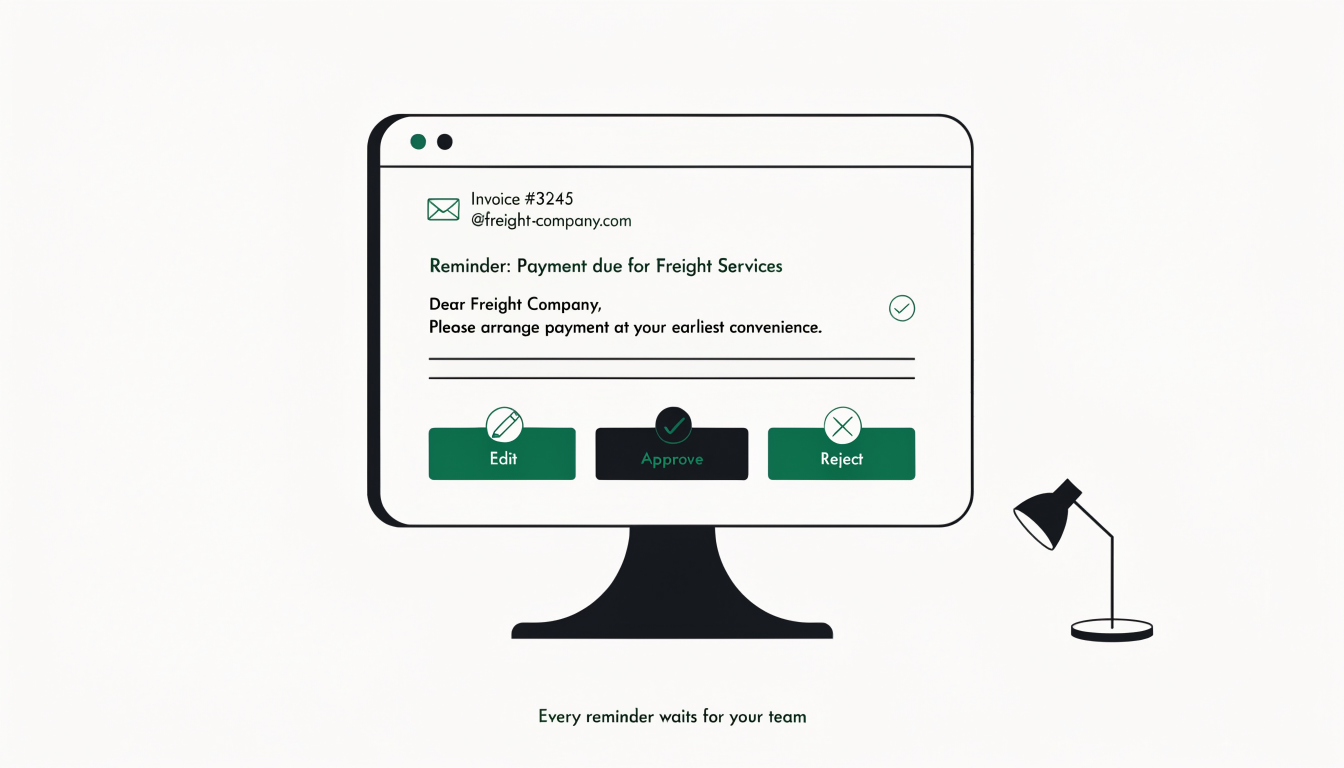
Crucially, Receivables AI ensures a human is always in the loop. Every message a customer sees waits for a person on your team, who can edit, approve, or reject it. The approved message goes out in their own name, maintaining the personal relationship. This combination of automation for routine tasks and human oversight for exceptions is built to bring DSO down without straining customer relationships.
If your AR ageing report is a source of frustration, it's time for a better system. The first step is to understand the scale of the opportunity. The next step is to bring your AR aging report to a session where we can show you how to apply these principles systematically.
Frequently Asked Questions
What is a good DSO for a freight forwarder?
There is no single "good" DSO, as it depends on your trade lanes, customer mix, and agreed payment terms. A DSO well above your agreed payment terms usually points to gaps in credit control or to credit extended too freely. The key is to track your own DSO trend over time and compare it to your contractual terms. You can learn more about what a good DSO looks like for a forwarder in our detailed guide.
Should post-dated cheques (PDCs) reduce DSO?
No. A post-dated cheque is a promise to pay in the future, not cleared funds. Reducing your accounts receivable (and thus your DSO) upon receipt of a PDC would understate your credit risk and provide a misleadingly optimistic view of your cash position. The invoice should be considered outstanding until the cheque has been deposited and has cleared the bank. PDCs should be tracked in a separate register for cash flow forecasting but not netted against your primary AR balance for DSO calculation.
Does TDS affect DSO?
Yes, TDS (Tax Deducted at Source) in India can affect your DSO, but only if it's managed incorrectly. When a customer deducts TDS and pays the net amount, the small residual balance left on the invoice should not be treated as an overdue customer debt. Once you have evidence of the deduction (e.g., it appears in your Form 26AS), that amount should be reclassified from a trade receivable to a tax receivable. If you leave it on the customer's account, it will artificially inflate your AR balance and your DSO.
Is DSO the same as average collection period?
Yes, Days Sales Outstanding (DSO) and Average Collection Period are two different names for the same financial metric. Both measure the average number of days it takes for a company to collect its accounts receivable after a sale. The DSO formula is the standard method for calculating this period.
How can I calculate DSO accurately if my sales fluctuate?
If your sales are seasonal or fluctuate significantly month-to-month, the standard monthly DSO calculation formula can be misleading. In this case, the "countback method" is a more accurate alternative. It works by subtracting sales month by month from your closing receivables balance to determine exactly how many days of sales are tied up in AR. This method gives more weight to recent sales and provides a truer picture of collection times in a dynamic sales environment.
Sources & References
This article draws on research and data from the following verified sources:
From reading to seeing.
Every idea on this page runs live in a working collections desk. Bring your aging report and watch.
Book the working sessionKEEP READING