A dunning letter is a written reminder asking a customer to pay an overdue invoice. For freight forwarders, a generic approach often fails. The most effective process runs four distinct stages—a courtesy reminder, a polite check, a firm reminder, and a final notice—with the wording of each stage tailored to the customer relationship. By creating three versions of each letter for key accounts, steady payers, and chronic late payers, a finance desk can cover nearly every scenario before handing the account to a person for the hard conversation. This tiered approach protects vital relationships while systematically recovering cash. For a complete overview of managing receivables in logistics, see the complete guide to freight collections.
What a dunning letter is, and why one letter does not fit every customer
Forwarders are banks that do not charge interest. You pay carriers, airlines, and customs authorities in days but often get paid by shippers in months. Your accounts receivable (AR) process is where that working capital comes back. A dunning letter is a critical tool in that process: a formal communication, usually one in a series, sent to a customer to collect payment on an overdue invoice.
The dunning sequence: a controlled escalation
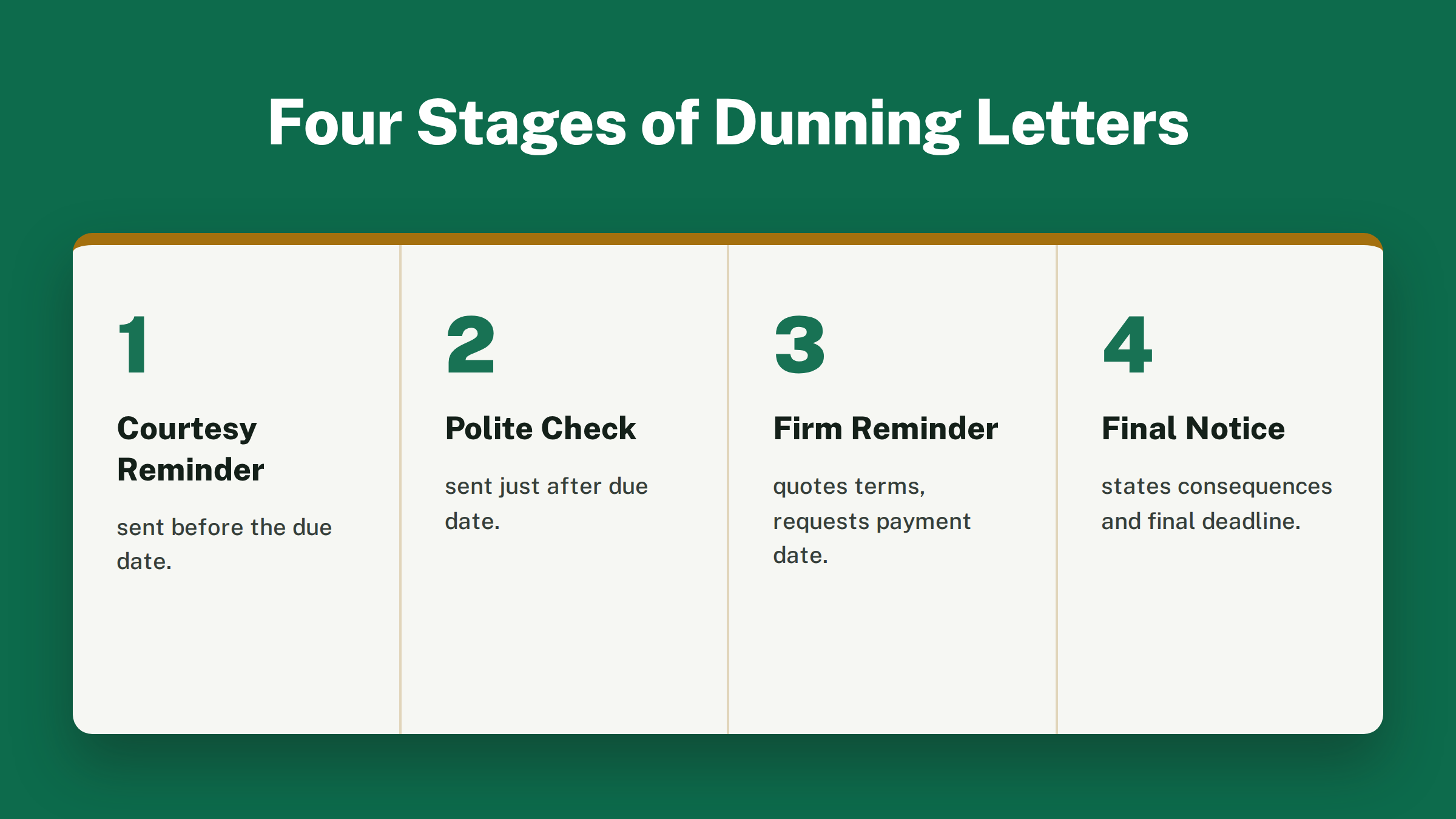
A dunning process is not a single letter but a sequence of communications that escalate in firmness and urgency. This multi-stage approach, often called a collection flow or dunning cycle, typically includes:
- A courtesy payment reminder letter sent just before or after the due date.
- One or more overdue notices that become progressively more direct.
- A final notice for payment that clearly states a deadline and the consequences of non-payment.
The goal is to prompt payment while preserving the customer relationship, resolving administrative hurdles, and creating a clear, documented record of communication for every overdue invoice.
Why a single template fails
The same wording lands differently depending on the recipient. Sending an aggressive collection email to your largest strategic account because their invoice is one day late can damage a valuable partnership. Conversely, sending a gentle nudge to a customer who has broken three payment promises is ineffective. A one-size-fits-all dunning letter either alienates good customers or fails to motivate chronic late payers.
Tying tone to the customer tier
Effective collections require segmentation. By classifying customers into tiers based on their payment history, volume, and strategic importance, you can tailor the tone and actions at each stage of the dunning cycle. This ensures you know how to chase payment politely with key partners while applying firm, consistent pressure where it's needed. A practical system uses three tiers: key accounts, steady accounts, and chronic late-paying or high-risk accounts.
The four stages of a freight forwarding dunning sequence
A structured, four-stage dunning process provides consistency and clarity. The timing between stages is not fixed by law; it should be set by your company’s credit policy and the customer's payment terms. The key is methodical escalation.
Stage 1: Courtesy reminder (before the due date)
The goal here is to prevent late payment by resolving administrative issues upfront. Send a polite reminder a few business days before the invoice is due. Attach the invoice and a current statement of account to make it easy for the customer's accounts payable team to process. This is a customer service touchpoint, not a demand.
Stage 2: Polite check (just overdue)
Once an invoice is a few days past its due date, send a polite follow-up. The objective is to determine if the payment has been scheduled or if there’s a problem, like a missing proof of delivery or a disputed charge. The tone remains helpful and assumes a simple oversight.
Stage 3: Firm reminder (quoting terms)
If the invoice remains unpaid after the initial check, the next dunning email becomes more formal. This message should reference the agreed-upon payment terms, state the number of days the invoice is overdue, and request a firm payment date. It signals that the issue has moved beyond a simple oversight.
Stage 4: Final notice (stating consequences)
The final written communication before personal escalation or other action. This final notice for payment must be clear and unambiguous. It should state a final deadline for payment and specify the consequences if that deadline is missed. Consequences should be actions you are contractually entitled to take and are fully prepared to enforce, such as placing the account on a credit hold for new bookings.
Stage 1 and 2 dunning letter templates by customer tier
Here are six copy-ready email templates for the first two stages of your dunning sequence, tailored for each customer tier. Remember to replace placeholders like [Name] and [invoice numbers] with specific details. Attaching a statement of account is crucial for helping customers with applying lump-sum payments to invoices correctly.
Tier 1: Key accounts
Stage 1: Courtesy Reminder
Subject: Courtesy reminder: Invoices due [due date]
Hello [Name],
This is a quick courtesy reminder that invoice(s) [invoice numbers] for [amount and currency] are due for payment on [due date].
We've attached the statement for your convenience. Please let us know if your AP team has everything they need. If payment is already in process, please disregard this note.
Kind regards,
[Your Name]
Stage 2: Relationship-Led Follow-Up
Subject: Following up on invoice(s) [invoice numbers]
Hello [Name],
I'm following up on invoice(s) [invoice numbers] for [amount and currency], which were due on [due date].
Could you please check the payment status with your finance team and let us know the expected remittance date? If there's any issue or query holding up payment, please let me know so we can resolve it for you immediately.
Thank you,
[Your Name]
Tier 2: Steady accounts
Stage 1: Standard Reminder
Subject: Payment Reminder: Invoice(s) [invoice numbers] due [due date]
Dear [Name],
This is a reminder that invoice(s) [invoice numbers], totaling [amount and currency], are due for payment on [due date]. A copy of your statement is attached.
Please arrange for payment by the due date. If payment has already been made, please send the remittance advice.
Regards,
[Your Name]
Stage 2: Overdue Action Request
Subject: Overdue Payment: Invoice(s) [invoice numbers]
Dear [Name],
Our records show that invoice(s) [invoice numbers] for [amount and currency] are now past their due date of [due date].
Please confirm the payment date by return email. If any part of this balance is disputed, please provide the specific invoice number and reason so we can investigate.
For India: If remitting after TDS, please confirm the net amount and provide TDS details.
Regards,
[Your Name]
Tier 3: Chronic late-paying accounts
Stage 1: Clear Due-Date Expectation
Subject: Action Required: Invoice(s) [invoice numbers] due [due date]
Dear [Name],
Invoice(s) [invoice numbers] for [amount and currency] are due for payment on [due date].
Please confirm that payment has been scheduled to meet this deadline. If you have any queries, they must be raised today to avoid payment delays.
Regards,
[Your Name]
Stage 2: Overdue with Deadline
Subject: URGENT: Overdue balance of [amount and currency]
Dear [Name],
The balance of [amount and currency] for invoice(s) [invoice numbers] is now overdue. Payment was due on [due date].
Please provide remittance advice for the full amount by end of business tomorrow, [Date]. Any undisputed amounts must be paid immediately. Failure to do so may affect the credit terms on your account.
For India: Confirm the net amount payable after TDS and provide the deduction certificate reference.
Regards,
[Your Name]
Stage 3 and 4 dunning letter templates by customer tier
When earlier reminders are ignored, the communication must become more formal. These Stage 3 and 4 templates escalate the request, culminating in a final notice. Crucially, only state consequences you are contractually permitted and operationally prepared to enforce.
Tier 1: Key accounts
Stage 3: Account Review Request
Subject: Action needed: Overdue balance on your account
Hello [Name],
I'm writing to you as the overdue balance of [amount and currency] on invoice(s) [invoice numbers] is now [number] days past due and requires your attention.
We value your partnership, so rather than follow a standard process, I'd like to resolve this directly. Could we schedule a brief call this week to understand the issue and agree on a payment date?
Please let me know what time works for you.
Best regards,
[Your Name/Account Manager]
Stage 4: Final Notice (Request for a Call)
Subject: Urgent request for a call: Overdue balance of [amount and currency]
Hello [Name],
Despite my previous attempts to connect, the balance of [amount and currency] remains outstanding, now [number] days overdue. This is a serious concern that we need to resolve.
This is our final reminder before we must formally review the credit terms for your account. To prevent this, please call me directly at [phone number] before [date] to confirm a payment plan.
I look forward to speaking with you.
Sincerely,
[Finance Head/Senior Manager]
Tier 2: Steady accounts
Stage 3: Firm Reminder with Terms
Subject: Overdue Invoices: Payment required by [date]
Dear [Name],
Further to our previous reminders, invoice(s) [invoice numbers] for [amount and currency] remain unpaid, now [number] days past our agreed [e.g., 30-day] terms.
Please arrange for immediate payment to be received no later than [date]. If payment is not received, we may be required to place your account on credit hold, which would affect future bookings. [If your terms or local law allow it: late-payment interest may also be applied.]
Regards,
[Your Name]
Stage 4: Final Notice for Payment
Subject: FINAL NOTICE: Overdue balance of [amount and currency]
Dear [Name],
This is a final notice for payment. The sum of [amount and currency] for invoice(s) [invoice numbers] is now critically overdue.
You must make payment in full within the next 5 business days, by [date].
If cleared funds are not received by this date, we will, without further notice, place your account on a stop-credit list and may refer the debt to a third-party collection agency.
Regards,
[Credit Control Department]
Tier 3: Chronic late-paying accounts
Stage 3: Formal Overdue Notice
Subject: FORMAL NOTICE: Account overdue, immediate payment required
Dear [Name],
Your account is in arrears. The balance of [amount and currency] for invoice(s) [invoice numbers] is now [number] days overdue, in breach of our agreed payment terms.
Immediate payment is required. If payment is not received within 48 hours, your account will be placed on credit hold, and all new shipments will require prepayment.
Regards,
[Credit Control Department]
Stage 4: Final Demand Before Action
Subject: FINAL DEMAND: Account balance of [amount and currency]
Dear [Name],
This is a final demand for payment of [amount and currency] on invoice(s) [invoice numbers].
Payment must be received by [date and time].
Failure to pay will result in the immediate suspension of all services and the commencement of formal debt recovery proceedings, for which you may be liable for additional costs and interest as permitted by law.
This is your final opportunity to settle this matter directly.
Sincerely,
[Finance Director]
Short versions for WhatsApp or chat
For customers who prefer informal channels, a person on your team can use these short, direct templates. These are for one-to-one messages to your known payment contact, not for automated broadcast. Never include sensitive bank details in a chat.
Stage 1: Due-date reminder
- "Hi [Name], quick reminder that invoice [INV-123] for [amount] is due today. Can you confirm it's scheduled?"
- "Morning [Name], just checking in on invoice [INV-123]. Please let me know if you need anything from our side to process it."
Stage 2: Overdue follow-up
- "Hi [Name], following up on invoice [INV-123] for [amount], which is now [X] days overdue. Please provide a payment date today."
- "Hi [Name], we need to close the books on invoice [INV-123]. It's now overdue. When can we expect payment?"
Operating rules for chat-based reminders
When using chat, always log the communication in your main system. Keep the messages factual and focused on the existing invoice. Keep them about the invoice only; do not add promotional content.
When the letters stop and a person calls
Automated dunning letters are efficient, but they have their limits. A person from your team must take over when the situation requires judgment, negotiation, or a senior-level conversation.
An invoice is genuinely disputed
If a customer disputes a charge, stop chasing and start investigating. This is especially common with complex pass-through costs. A phone call is necessary to clarify the exact issue, whether it's related to rates, accessorials, or documentation. This is critical for invoices blocked by detention and demurrage disputes, where specific evidence is required. For example, the U.S. Federal Maritime Commission's 2024 rules require specific information on D&D invoices, and failure to provide it can eliminate the obligation to pay (FMC).
The customer repeatedly breaks payment promises
When a customer makes a promise to pay and misses the date, an automated "overdue" reminder is pointless. A person needs to call and ask not "when will you pay?" but "You committed to pay on [date]. That has passed. What is the new, firm date?" This conversation is about accountability, not just scheduling.
The balance is large or significantly past terms
Your credit policy should define triggers for manual intervention based on the total amount outstanding or the number of days past due. A large, aging debt poses a risk to your cash flow and requires a direct conversation to assess the situation, negotiate a payment plan, or make a tough decision about future business.

What the caller needs to know
Before picking up the phone, your team member needs the complete history in one place: all open invoices, past communications, previous payment promises, and any dispute details.
Where Receivables AI fits into your collections desk
Managing a four-stage, three-tier dunning system manually across hundreds of customers is complex. This is where a dedicated tool like Receivables AI, built on FreighAI, works alongside your team to run the process while keeping you in control.
Setting the tone for every customer
Receivables AI allows you to implement the tiered system automatically. Based on rules you set, it sets the tone of each payment reminder to the customer: warmer for a key account, firmer for a chronic late payer. The system can also move customers between tiers based on their actual payment behavior, ensuring the right level of pressure is always applied.
Tracking every promise to pay
A key failure in manual collections is losing track of commitments. Receivables AI tracks every promise to pay and follows up when a promised date slips. If a customer replies with a payment date, the system pauses reminders and follows up if the payment does not arrive as promised; that follow-up, like every message, waits for a person to approve it.
Keeping the conversation in one place
Instead of chasing information across different email threads and spreadsheets, the system keeps all follow-ups, chasers, and reminders in a single, continuous conversation for each invoice. This gives anyone on your team a complete, real-time view of the account's history.
Putting your finance team in control
This is not a "black box" system. The rules and timing for chasers and reminders are set by the head of operations or an admin. Most importantly, a person approves every message written to a customer; an approved message goes out in their own name. This combines the efficiency of automation with the judgment of your experienced team. To see a detailed breakdown, explore freight collections compared with generic AR tools or see how the desk works.
Ready to see how much cash is stuck in your receivables? Don't just bring your problems; bring your AR aging report to a demo and see how a structured approach can work for you.
Frequently Asked Questions
What is a dunning letter?
A dunning letter is a written communication sent to a customer to collect payment for an overdue invoice. It is typically part of a series of reminders that escalate in tone and urgency, starting with a gentle reminder and potentially ending with a final demand before further collection action is taken. The purpose is to prompt payment while maintaining a documented communication trail.
How many dunning letters should I send before escalating?
A common and effective practice is to use a four-stage process before escalating to a personal phone call or other action. This includes: 1) a courtesy reminder before the due date, 2) a polite check just after the due date, 3) a firmer reminder quoting payment terms, and 4) a final notice stating a deadline and consequences. After these four attempts, if payment or a resolution is not secured, the account should be handled by a person.
What should a final notice for payment include?
A final notice for payment should be clear, formal, and unambiguous. It must include the specific invoice numbers, the total outstanding amount, a final, non-negotiable payment deadline (e.g., "within 5 business days"), and the specific consequences of non-payment. These consequences should be actions you are contractually entitled to and will enforce, such as placing the account on credit hold or referring the debt to a collection agency.
Should dunning letters be different for different customers?
Yes, absolutely. A one-size-fits-all approach is inefficient. You should tailor the tone and content of your dunning letters based on the customer relationship. A strategic, high-volume customer should receive a more collaborative, relationship-focused reminder, while a customer with a history of late payments requires a firmer, more direct approach from the outset.
How do I handle a disputed invoice in the dunning process?
When a customer disputes an invoice, you should immediately pause the automated dunning sequence for the disputed amount. The next step is for a person on your team to contact the customer to understand the exact nature of the dispute. Request that the customer pay the undisputed portion of the invoice while you investigate the disputed item. Document the dispute and the investigation process in your system.
Sources & References
This article draws on research and data from the following verified sources:
From reading to seeing.
Every idea on this page runs live in a working collections desk. Bring your aging report and watch.
Book the working sessionKEEP READING