
Every day an invoice sits unpaid is a day your cash is funding your customer’s business. For a freight forwarder, who pays carriers in days and gets paid by shippers in months, this gap is where working capital disappears. This makes Days Sales Outstanding (DSO) more than just a metric; it’s a measure of your company’s financial health. But the first question finance heads ask is often the hardest to answer: what is a good DSO for a freight forwarder? This article gives the honest answer, and for a complete overview of the process, see the complete guide to freight collections.
The short answer
There is no single, published DSO benchmark for freight forwarders. A good DSO is one that is close to your own average credit terms. As a working rule—ours, not an industry standard—a DSO that is more than about two weeks above your agreed terms deserves immediate attention.
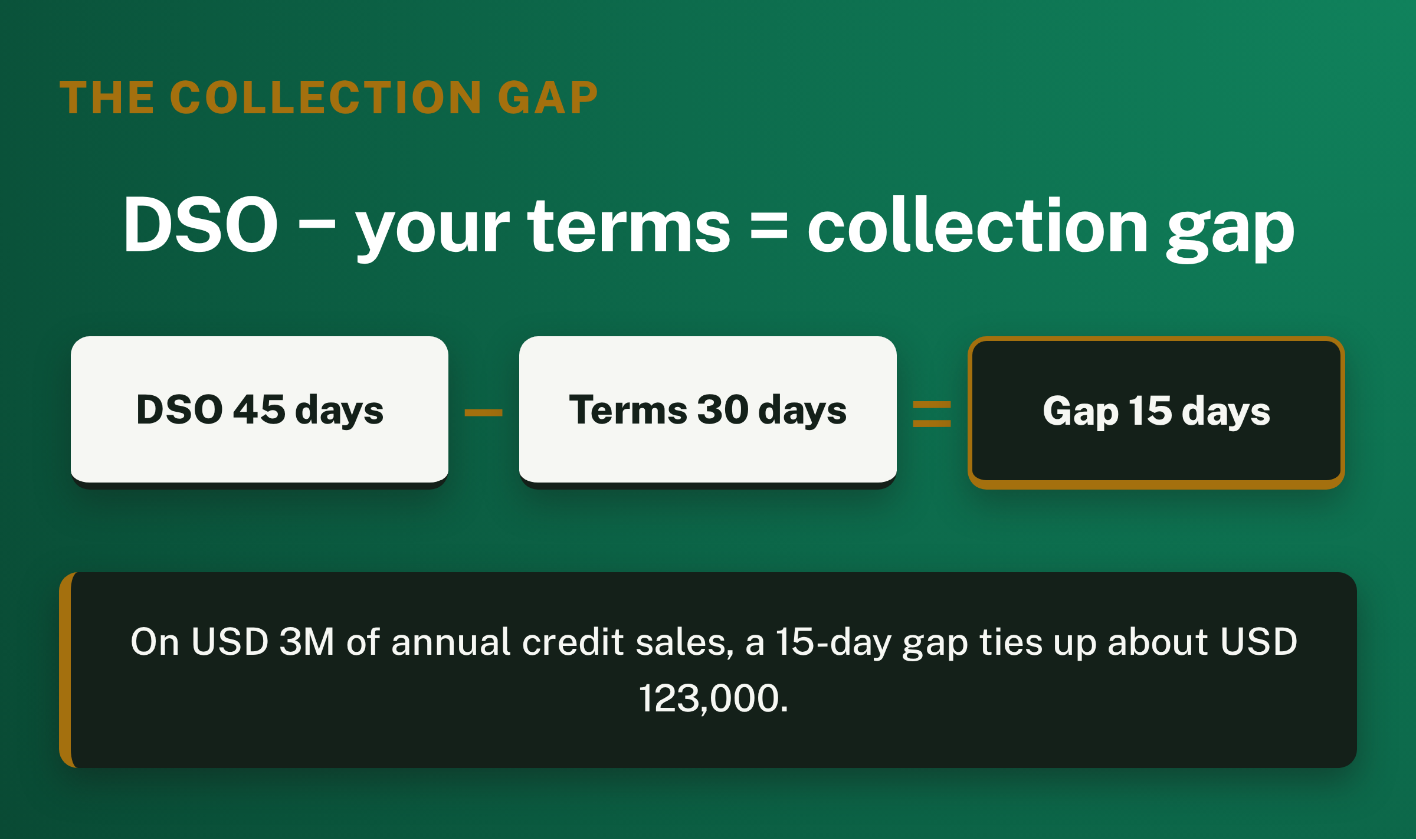
The number itself is meaningless without context. A DSO of 45 days is a 15-day collection gap for a forwarder selling on 30-day terms. That same 45-day DSO is excellent performance for a forwarder whose customers have 60-day terms. The right question is not “what is a good DSO?” but “what is the gap between my DSO and my terms?”
Why there is no single good number
Finance teams look for benchmarks, but for freight forwarding, a universal DSO target is misleading. We have found no credit insurer, rating agency or trade body that publishes a forwarder-specific DSO table. The reasons are fundamental to how the industry works.
Credit terms differ by customer and market
A forwarder’s customer base is diverse. A small importer might pay on 15-day terms, while a large multinational shipper has negotiated 60-day terms. A forwarder handling project cargo may have milestone-based payments. These businesses cannot share a single DSO target.
Forwarders are banks that do not charge interest
The core problem is the cash conversion cycle. A freight forwarder pays carriers, airlines, agents, and port authorities before the customer pays the final invoice. Every shipment is a small, interest-free loan. Every day of DSO represents cash that has left your bank account to pay a supplier but has not yet returned from the customer. This funding mechanism means that a high DSO isn't just a number on a report; it's a direct drain on your cash reserves.
The reference points that do exist
While there is no specific DSO for logistics companies, several reputable sources publish all-sector data that provides valuable context. These figures show the broader payment environment your customers operate in. They are reference points, not targets.
It is critical to remember these are all-sector figures, not logistics-specific benchmarks. You can explore the full table of reference points for more detail.
| Finding | Figure | Source |
|---|---|---|
| Global DSO reached a multi-year high at the end of 2023, marking the largest annual rise since 2008. | 59 days | Allianz Research, 4 April 2024 |
| Global DSO continued to rise in 2024, with a significant portion of firms experiencing long payment delays. | Rose by >2 days | Allianz Research, 18 June 2025 |
| At the end of 2024, 44% of firms had a DSO above 60 days, and 21% were above 90 days. | 44% >60 days; 21% >90 days | Allianz Research, 18 June 2025 |
| In India, overdue invoices are a significant issue in B2B trade, affecting a majority of credit sales. | 63% of credit sales affected | Atradius Payment Practices Barometer, India 2025 |
| Bad debts in India represent a material percentage of B2B invoices. | 7% of B2B invoices | Atradius Payment Practices Barometer, India 2025 |
| In the UAE, overdue invoices affect more than half of B2B sales. | 58% of B2B sales affected | Atradius Payment Practices Barometer, UAE 2025 |
| In Asia, 40% of companies reported ultra-long payment delays (over 180 days and above 2% of annual revenue), and in Coface's experience, 80% of these are never paid. | 40% report ultra-long delays | Coface Asia Payment Survey 2025 |
How to read your own DSO
A single DSO number is a blunt instrument. To get a true picture of your freight forwarder accounts receivable health, you need to look at it from multiple angles. The question is not just "what is a good DSO," but what is my DSO telling me about my cash flow and risk?
Against your weighted average terms
The most important comparison is your DSO against the credit terms you actually sell on. The formula is simple: DSO - Weighted Average Terms = The Collection Gap. This gap is the number of days you are funding your customers beyond your agreed terms. This is the number that your credit control team should be focused on reducing. If you're unsure of the calculation, see our guide on how to calculate DSO when dealing with complex payments like statements or TDS deductions.
Trend over level
A steady DSO of 50 days is often healthier than a DSO that has drifted up from 35 to 45 days over two quarters. A rising trend signals a potential problem in your collections process, a change in customer payment behaviour, or an increase in disputes. Monitor your DSO monthly and quarterly to catch negative trends before they become critical.
Distribution over average
A healthy average DSO can hide a dangerous secret: a growing balance in your 90+ day aging bucket. That Coface finding that 80% of ultra-long delays are never paid should be a stark warning. Your AR aging freight forwarder report is more important than your single DSO number. A high concentration of debt in the oldest buckets poses a serious bad-debt risk, even if your overall DSO looks acceptable.
Per customer, not only company-wide
One large, slow-paying customer can skew your entire company's DSO. Analyse DSO on a per-customer basis. This helps you identify which accounts are straining your working capital and allows your sales and operations teams to have informed conversations about credit limits and payment performance. A customer who is profitable on paper but pays 60 days late may be a net loss to your business.
What the gap costs: a worked example
The gap between your DSO and your terms has a real, calculable cash cost. Let's take a mid-sized freight forwarder as an example.
- Annual Credit Sales: USD 3,000,000
- Average Daily Credit Sales: USD 3,000,000 / 365 days = USD 8,219 per day
Now, let's assume this forwarder offers standard 30-day credit terms, but their actual measured DSO is 45 days.
- The Collection Gap: 45 days (Actual DSO) - 30 days (Terms) = 15 days
- Cash Tied Up: 15 days x USD 8,219 per day = USD 123,285
That 15-day gap means approximately USD 123,000 of the company’s cash is tied up in accounts receivable, beyond what its credit terms already allow. This is cash that could be used to invest in growth, hire staff, or simply strengthen the balance sheet. Instead, it's funding customers, while the carrier, airline, and port have already been paid. Want to run the numbers for your own business? Use our simple tool to see how much cash is stuck.
How to bring DSO closer to terms
Reducing the gap between DSO and terms is a core function of an effective finance and credit control freight forwarder team. It requires discipline, process, and the right tools. Answering "what is a good DSO" is less important than actively working to improve it.
Track DSO daily and per customer
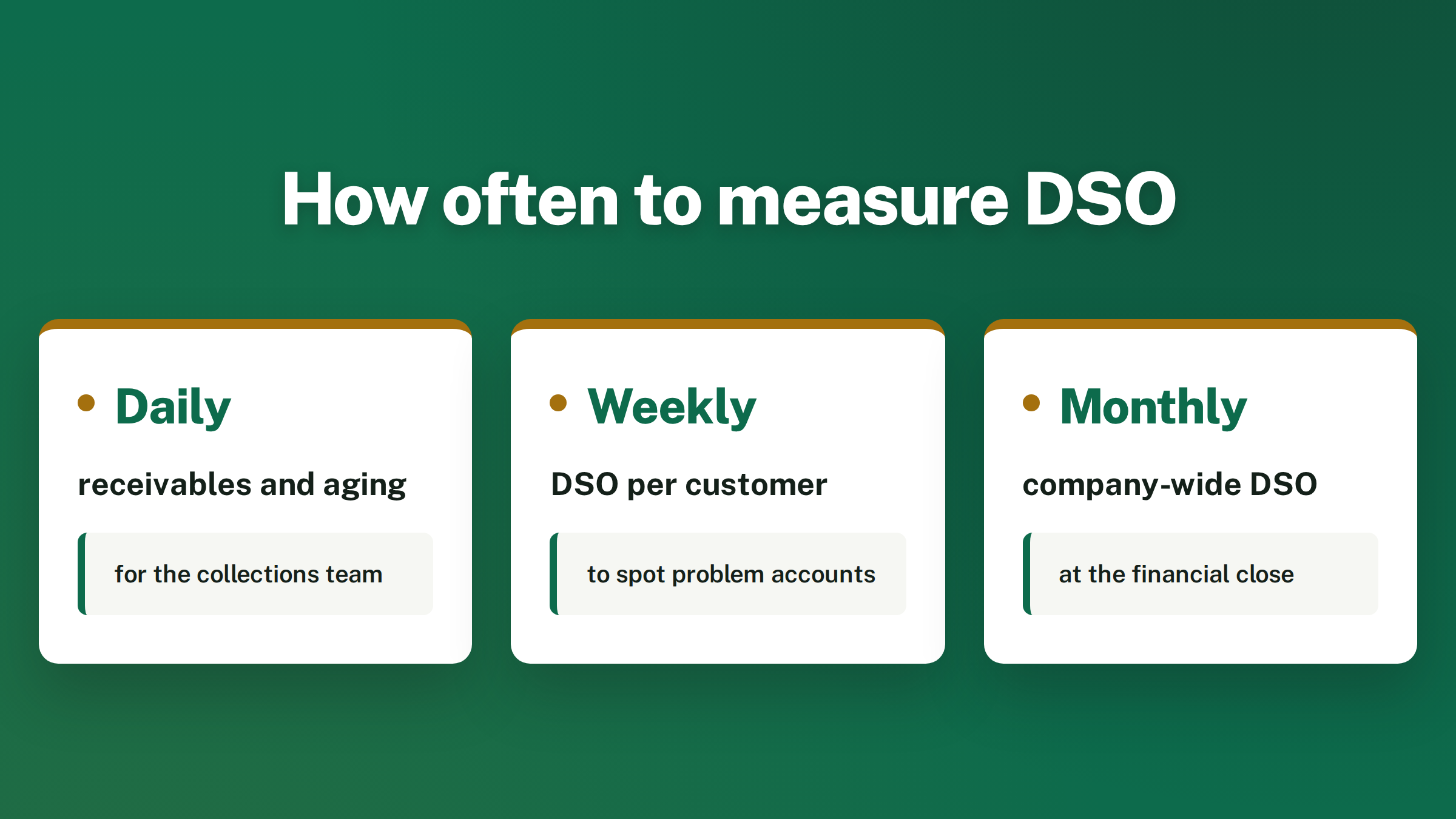
Collections is a daily activity, not a month-end report. Your team needs a live view of receivables, tracked by customer and by invoice. Waiting for the month-end closing report is too late; the damage is already done.
Remind before the due date, not only after
The most effective collection activities happen before an invoice becomes overdue. A polite reminder a week before the due date to confirm the invoice is approved for payment is a service, not a demand. It helps uncover issues like missing POs or incorrect documentation while there is still time to fix them and get paid on time.
Resolve disputes early
An invoice under dispute is an invoice that is not being paid. Whether it's a rate discrepancy, a detention charge, or a missing proof of delivery, disputes must be identified and resolved immediately. A clear process for short pay reconciliation and dispute management is essential to improve DSO freight performance.
Record every promise to pay
A verbal "the check is in the mail" is not a collection. Every promise to pay freight invoices must be documented with a specific date and amount. Your system should automatically flag a follow-up for the day the payment is due. This discipline turns vague promises into accountable commitments.
For many forwarders, managing this process across hundreds of customers and thousands of invoices via email and spreadsheets is hard to keep up. This is the work Receivables AI takes on. Follow-ups, chasers, and reminders happen on their own, on the same conversation thread, ensuring nothing is missed. The rules and timing for these chasers are set by your head of operations or an admin. Crucially, every message a customer sees waits for a person on your team, who can edit, approve, or reject it. An approved message goes out in their own name, maintaining your customer relationship. You can see how the desk works to manage this process without losing control.

Frequently Asked Questions
What is a good DSO for a logistics company?
There is no single published benchmark for a good DSO for a logistics company. The best measure is one that is close to your own weighted average credit terms. For example, if your average terms are 30 days, a DSO of 35-40 days might be considered good, as it indicates customers are paying, on average, within 5-10 days of the due date. A DSO significantly higher than your terms suggests a problem with collections or disputes.
Is a DSO of 60 days good?
Whether a DSO of 60 days is good depends entirely on your payment terms. If your contracts with major customers specify 60-day payment terms, then a DSO of 60 is excellent—it means you are getting paid exactly on time. However, if your standard terms are 30 days, a DSO of 60 indicates a significant 30-day cash flow gap and a serious collections issue that needs immediate attention.
What is the best possible DSO?
The best possible DSO is one that is equal to or even slightly below your weighted average credit terms. A DSO below your terms means that, on average, your customers are paying you early. While this is rare, it can be achieved with a mix of customers on prepayment terms, early payment discounts, and an exceptionally efficient collections process.
How often should DSO be measured?
DSO should be monitored at multiple frequencies. A company-wide DSO should be calculated and reviewed at least monthly as part of your financial closing process. However, for operational management, it's far more effective to track receivables and aging on a daily basis. Customer-level DSO should also be reviewed weekly or monthly to identify problem accounts before they impact the company-wide average.
Ready to get control of your cash flow? The first step is understanding your real exposure. Bring your AR aging report to a session with our team, and we'll walk through where your cash is sitting and what to chase first.
Sources & References
This article draws on research and data from the following verified sources:
- Allianz Research, 4 April 2024: The cost of pay me later
- Allianz Research, 18 June 2025: Cash back to shareholders or cash stuck to finance customers?
- Atradius Payment Practices Barometer: B2B payment practices trends in India 2025
- Atradius Payment Practices Barometer: B2B payment practices trends in the UAE 2025
- Coface Asia Payment Survey 2025
From reading to seeing.
Every idea on this page runs live in a working collections desk. Bring your aging report and watch.
Book the working sessionKEEP READING